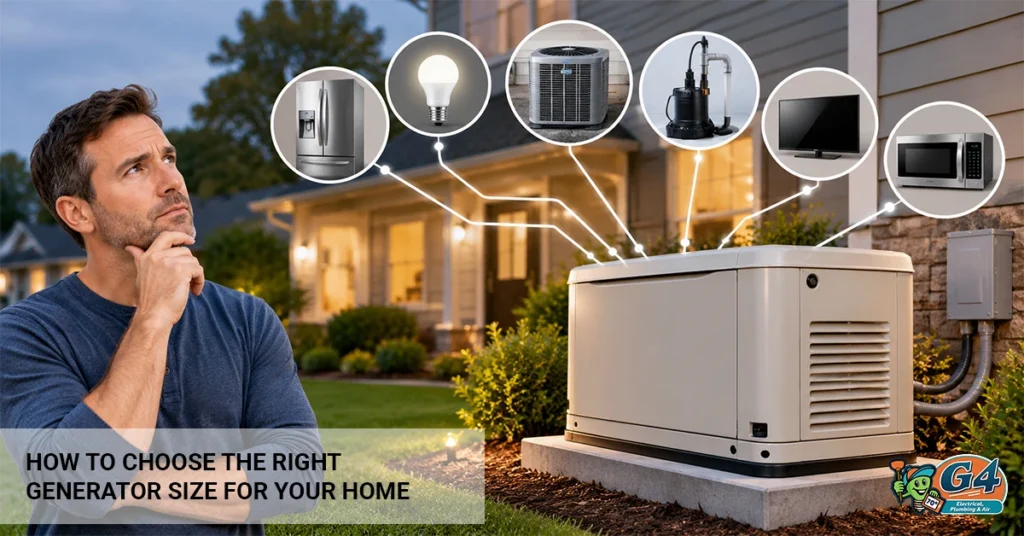
Choosing the right generator starts with knowing which appliances you need during a power outage. Your generator must supply enough power to run them and handle the extra power some appliances need when they start.
A generator that is too small may not start your refrigerator, water pump, or air conditioner. A unit that is too large may cost more than you need to spend.
You can find the right size by checking your appliances’ power needs and deciding which ones must run at the same time.
What Size Generator Do You Need for Your Home?
Most homes need a generator rated between 3,000 and 10,000 watts to run basic appliances and selected circuits. If you want backup power for most of your home, you may need a standby generator rated at 10,000–20,000 watts or more.
The right size depends on what you want to power. A small generator may run your refrigerator, lights, and fans. Running central air conditioning, electric heating, or several large appliances at once may require much more power.
For help choosing the right backup power system, explore our home generator installation services.
Use this table as a starting point.
| Generator size | Typical use |
|---|---|
| 2,000–3,500 watts | Lights, small devices, and a few basic appliances |
| 3,500–5,500 watts | Refrigerator, lights, fans, and some extra appliances |
| 5,500–7,500 watts | More basic appliances and selected home circuits |
| 7,500–10,000 watts | Larger loads, depending on startup needs |
| 10,000–20,000 watts | Backup power for many household needs |
| 20,000+ watts | Homes with high power needs and many whole-home systems |
These ranges are estimates, not fixed rules. For example, a 7,500-watt generator may run several basic appliances but struggle to start a central air conditioner while other equipment is running.
Before buying, check two power ratings:
- Running watts: The power a generator can supply over time.
- Starting watts: The extra power it can supply for a short time when certain appliances start.
Make a list of the appliances you want to run and add up their power needs. If you want to run central air conditioning or most of your home, ask a qualified electrician to check your power needs. They can help you choose the right generator or decide whether a load-management system would help.
How to Calculate the Generator Size for Your Home
To work out the generator size you need, list the appliances you want to use, check their running and starting watts, and add up their power needs. This helps you choose a generator that can run your essential appliances during an outage.
Step 1: List the Appliances You Need to Power
Start by listing the appliances you want to keep running during a power outage. You don’t need to power everything in your home at once.
Your list may include:
- Refrigerator and freezer
- Lights and ceiling fans
- Television, computers, and phone chargers
- Microwave
- Sump pump or well pump
- Furnace or heating system
- Window or central air conditioner
- Electric water heater
- Other essential appliances
Separate the items you need from those you can switch off during an outage. For example, you may want to keep your refrigerator, lights, fans, and sump pump running. You may not need to use your electric oven or clothes dryer.
This helps you work out how much power you need without paying for a larger generator than necessary.
Step 2: Check the Running Watts of Each Appliance
Running watts show how much power an appliance needs during normal use. You can usually find this number on the appliance label, in the owner’s manual, or on the maker’s website.
If the label shows volts and amps instead of watts, you can estimate the power with this formula:
Watts = Volts × Amps
For example, a device that uses 120 volts and draws 5 amps has a rating of 600 volt-amperes. This equals 600 watts when the power factor is 1. Some motors and electronic devices may use a different amount of actual power, so check the maker’s details when possible.
Here are the estimated running watts of common home appliances.
| Appliance | Estimated running watts |
|---|---|
| Refrigerator | 150–800 W |
| LED lights used together | 50–300 W |
| Television | 50–200 W |
| Laptop | 50–100 W |
| Microwave | 800–1,500 W |
| Window air conditioner | 500–1,500 W |
| Sump pump | 500–1,500 W |
| Electric water heater | 3,000–4,500 W |
These numbers are estimates. Actual power use depends on the size, model, and type of appliance. A microwave, for example, may draw more power than its stated cooking output.
Pay close attention to appliances that use a lot of power, such as electric water heaters and air conditioners. They can use a large part of your generator’s available power.
Step 3: Check the Starting Watts
Starting watts show the extra power an appliance may need when its motor or compressor starts. Some appliances need much more power at startup than they do while running.
Common examples include:
- Refrigerators and freezers
- Air conditioners
- Sump pumps
- Well pumps
- Other appliances with electric motors
For example, a refrigerator may use 200 watts while running but need much more power to start its compressor. The exact amount depends on the model.
Check the maker’s details for starting watts or locked-rotor amperage (LRA), where listed. Do not assume every appliance needs the same extra power.
Why do starting watts matter? A generator may have enough power to run your appliances but still fail to start a motor if it cannot supply the extra power needed at startup.
Step 4: Add Up the Running Watts
Add the running watts of all the appliances you plan to use at the same time. This gives you an estimate of the power your generator must supply during normal use.
For example, you may want to run these appliances during an outage:
| Appliance | Running watts |
|---|---|
| Refrigerator | 700 W |
| Lights | 300 W |
| Television | 150 W |
| Microwave | 1,200 W |
| Sump pump | 1,000 W |
| Total running load | 3,350 W |
The total running load is 3,350 watts. Your generator must be able to supply at least this amount of power continuously.
You don’t need to count every appliance in your home. Include only the items you plan to run at the same time. However, remember that refrigerators, pumps, and other appliances may start on their own. You must also allow for the extra power they need to start.
Step 5: Allow for the Largest Starting Load
To account for starting watts, add the extra power needed to start the largest motor-driven appliance to the running load of the appliances already in use.
For example, suppose your total running load is 3,350 watts. Your sump pump uses 1,000 watts while running and needs 2,000 watts to start. It therefore needs an extra 1,000 watts at startup.
Your estimated power demand would be:
3,350 W + 1,000 W = 4,350 watts
This example assumes the sump pump starts while the other appliances are running and their startup needs do not overlap.
Check the startup needs of your other appliances, too. If several motors may start at the same time, you may need a generator with more starting power. For complex setups, ask a qualified electrician to work out the total power needs.
Step 6: Choose a Generator With Enough Power
Choose a generator that can handle your total running load and the extra power needed to start your appliances. Check both power ratings before you buy.
- Rated running watts: The power the generator can supply over time under its stated conditions.
- Starting or surge watts: The extra power it can supply for a short time to start suitable appliances.
In the example above, your appliances need 3,350 running watts and about 4,350 watts when the sump pump starts. Look for a generator with at least 3,350 rated running watts and enough starting power to meet that extra demand.
A generator rated around 4,500–5,000 running watts may be a starting point. Check its full ratings and your appliances’ actual power needs before choosing a model.
Also think about fuel supply, where you will use the generator, and whether you may add more appliances later. If you plan to run central air conditioning or several large appliances, ask a qualified professional to check your power needs first.
Generator Size Examples for Different Homes
The right generator size depends on the appliances you need to run, not just your home’s square footage. A smaller home may need only a few thousand watts for basic appliances. A home with central air conditioning, electric heating, or several large appliances may need much more power.
What Size Generator Does a Small House Need?
A small house may need a generator rated at around 3,000–5,000 running watts for basic appliances, lights, fans, and selected devices.
Your needs will depend on the equipment you want to use. A home with a refrigerator, lights, and fans may need less power than one with a well pump, electric water heater, or air conditioner.
List your essential appliances, add up their running watts, and allow for the extra power needed to start motors and compressors. Then choose a generator that can handle both.
What Size Generator Does a 2,000-Square-Foot House Need?
A 2,000-square-foot home may need a 5,000–10,000-watt generator for selected home circuits. A system that powers most of the home may need more capacity.
Square footage alone cannot tell you which generator to buy. Two homes of the same size can have very different power needs.
Consider these points:
- Whether your heating system uses gas or electricity.
- Whether you need central air conditioning.
- How many refrigerators, pumps, and other large appliances you have.
- Whether you want to power a few circuits or most of your home.
- Whether a load-management system can control large appliances.
For a better estimate, add up the running and starting watts of the appliances you want to use. If you want backup power for most of your home, ask a qualified electrician to check your power needs and suggest the right size.
What Size Generator Do You Need to Run Central Air Conditioning?
The size of the generator you need for central air conditioning depends on the AC unit’s power needs, its startup demand, and the other appliances you want to run at the same time.
Central AC systems may need a large amount of power when the compressor starts. For this reason, do not choose a generator based on the AC unit’s BTU rating alone.
Before buying, check the AC unit’s label and maker’s details for its power needs, including startup demand. A qualified HVAC technician or electrician can help you work out the right generator size.
A compatible soft-start device may lower the power needed to start some AC systems. It must suit your equipment and be fitted according to the maker’s instructions. You will still need a generator that can run the AC and other connected appliances.
What Size Generator Do You Need for Whole-Home Backup?
A whole-home backup system may need a generator rated at 10,000–20,000 watts or more. The right size depends on your home’s power needs and which appliances you want to run at the same time.
Before choosing a system, review our guide to whole-home generator installation costs to understand the potential cost of your project.
Your generator may need to power heating and cooling systems, refrigerators, lights, pumps, and other large appliances. Homes with electric heating, central AC, or several high-power devices may need more capacity.
The best way to find the right size is to ask a qualified electrician to check your home’s power needs. They can suggest a suitable generator and tell you whether a load-management system would help.
Load management lets selected appliances run at different times. This can reduce the need to power every large appliance at once.
Keep in mind that a generator sold for whole-home backup may not run every appliance at the same time. Check its rated running watts, starting watts, and fit with your home’s electrical system before you buy.
Portable vs. Standby Generator Sizing
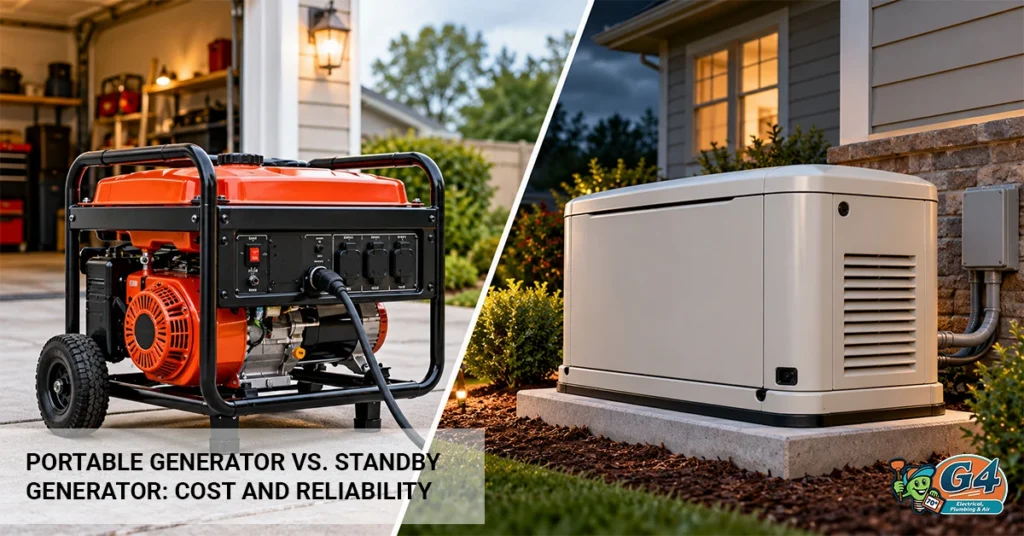
Portable and standby generators can both power your home during an outage. The right size depends on how many appliances you need to run. Portable models often suit basic appliances and selected circuits, while standby systems can handle larger loads when sized correctly.
How Much Power Can a Portable Generator Provide?
A portable generator may supply a few thousand watts or more than 10,000 watts, depending on the model. Smaller units can run basic appliances, while larger models may power more home circuits.
Before choosing one, add up the running watts of your appliances and allow for the extra power needed to start motors and compressors. Make sure the generator can handle both.
If you want to connect a portable generator to your home’s circuits, use a properly fitted transfer switch or another approved connection system. Never plug a generator into a normal wall outlet to power your home’s wiring. This can send power back into utility lines and put workers at risk.
A qualified electrician can help connect your generator safely through our electrical installation services.
How Is a Standby Generator Sized?
A standby generator is sized based on your home’s power needs and the appliances you want to run during an outage. Depending on its capacity and setup, it can power a few circuits or much of your home.
Standby generators usually start on their own when utility power fails, as long as the generator and transfer system work as they should. However, automatic startup does not mean every appliance can run at once.
A qualified installer can check your electrical panel, add up the running and starting watts, and decide whether you need a larger generator, load management, or electrical work.
If your backup power system needs changes to your electrical panel, learn more about our electrical panel services.
Getting the size right is especially important if you want to run central air conditioning, electric heating, or several large appliances. It helps ensure your generator can meet your power needs safely and reliably.
Common Generator Sizing Mistakes to Avoid
Choosing the wrong generator size can leave important appliances without power, cause startup problems, or raise your costs. Avoid these common mistakes when choosing a generator for your home.
- Choosing based only on square footage: The size of your home does not show how much power you need. List your appliances and add up their wattage.
- Ignoring starting watts: Refrigerators, sump pumps, and air conditioners may need extra power when they start.
- Adding up the wrong appliances: Count the appliances you plan to run at the same time. Include equipment that may start on its own.
- Missing large power loads: Central AC, electric heating, water heaters, and well pumps can raise the amount of power you need.
- Mixing up running and starting watts: Check both ratings to make sure the generator can run your appliances and start them.
- Looking only at peak watts: Peak or starting watts do not show how much power a generator can supply all the time. Make sure its rated running watts meet your needs.
- Forgetting about fuel: Check fuel use, runtime, and fuel supply. This matters when an outage lasts for hours or days.
- Using unsafe connections: Have a qualified electrician fit an approved transfer switch or other suitable system. Never plug a generator into a normal wall outlet to power your home’s wiring.
Working out your power needs before buying can help you choose a generator that runs your essential appliances without extra cost. If you are unsure, ask a qualified electrician to check your home’s power needs.
Should You Choose a Generator With Extra Capacity?
A generator with some extra capacity can help handle startup surges and allow for changes in your power needs. However, buying a larger generator is not always the best choice.
Extra capacity may help if you plan to add appliances, run more devices at once, or power equipment that needs a lot of power to start, such as central air conditioners and sump pumps.
A larger generator may cost more to buy and install. Fuel use also varies by model and how much power you draw, so check the maker’s details before comparing units.
The best choice is a generator that meets your home’s running and starting power needs, with some room for future use. This helps you avoid buying a unit that is too small or paying for power you will not use.
Generator Sizing and Safety Tips
Choosing the right generator size is only one part of planning for backup power. Safe setup, proper wiring, fuel use, and generator placement matter just as much. If you have problems with your home’s electrical circuits or connections, see our electrical repair services.
Follow these safety tips when installing or using a home generator:
- Ask a qualified electrician: Have an electrician check your home’s power needs before connecting a generator to home circuits.
- Use safe connections: Fit a properly rated transfer switch or another approved system. Never plug a generator into a normal wall outlet to power your home’s wiring.
- Keep portable generators outdoors: Place fuel-powered portable generators at least 20 feet from your home. Point the exhaust away from doors, windows, and vents.
- Avoid closed spaces: Never run a portable generator inside a garage, basement, shed, or any enclosed or partly enclosed area.
- Fit carbon monoxide alarms: Install and maintain CO alarms as directed by the maker and local rules.
- Follow the maker’s instructions: Use the right fuel, carry out regular care, and follow all safety and weather guidelines.
- Check local rules: Find out whether you need permits or must meet local codes before installing a permanent standby generator.
Fuel-powered generators produce carbon monoxide (CO), a gas that has no smell or color and can be deadly. Safe placement, proper airflow, and correct wiring are vital, whatever size generator you choose.
Frequently Asked Questions
What size generator do I need to power my whole house?
Many homes need a generator rated around 10,000–20,000 watts for whole-home backup. The right size depends on your power needs and which appliances you want to run at the same time. Homes with central AC, electric heating, or other large appliances may need more power. A professional power check can help you choose the right size.
Is a 7,500-watt generator enough for a house?
A 7,500-watt generator may run basic appliances and selected home circuits, depending on their running and starting watts. It may not run central AC, electric heating, and several large appliances at the same time. Check the generator’s ratings and add up your power needs before buying.
Can a 5,000-watt generator run a refrigerator and air conditioner?
A 5,000-watt generator may run a refrigerator and an air conditioner if it can handle their running and starting power needs. The result depends on the models you have and what else is running. Check the appliance details before choosing a generator.
How many watts does a typical house use?
A home’s power needs depend on its size, climate, heating and cooling systems, and appliance use. Average power use does not always show the highest demand during an outage. To choose a generator, add up the watts of the appliances you plan to run at the same time.
Should I size a generator for starting watts or running watts?
You need to check both. Running watts show how much power the generator can supply over time. Starting watts show whether it can handle the short burst of power needed by appliances with motors or compressors. Choose a generator that meets both needs.
Can a generator be too big for a house?
Yes. A generator with far more power than you need may raise equipment and installation costs without much extra benefit. However, you still need enough power for startup surges and possible future needs. Add up your expected power use before choosing a generator.
How do I calculate the watts needed for a home generator?
List the appliances you want to run and check their running and starting watts. Add the running watts of the appliances that will operate at the same time. Then allow for the extra power needed to start motors and compressors. Compare your results with the generator’s running and starting ratings. For whole-home backup, ask a qualified electrician to check your power needs.
Final Thoughts
Choosing the right generator size starts with knowing which appliances you need during an outage and checking their running and starting watts. You can then compare models and decide whether a portable or standby generator suits your home.
Do not choose a generator based only on your home’s size or the highest wattage shown in an advert. Check its rated running power, allow for startup needs, and think about fuel supply and future use.
If you want backup power for most of your home or need to run large appliances such as central AC, ask a qualified electrician to check your power needs and plan a safe setup.
A generator that is the right size can keep your essential appliances running during an outage without making you pay for more power than you need.