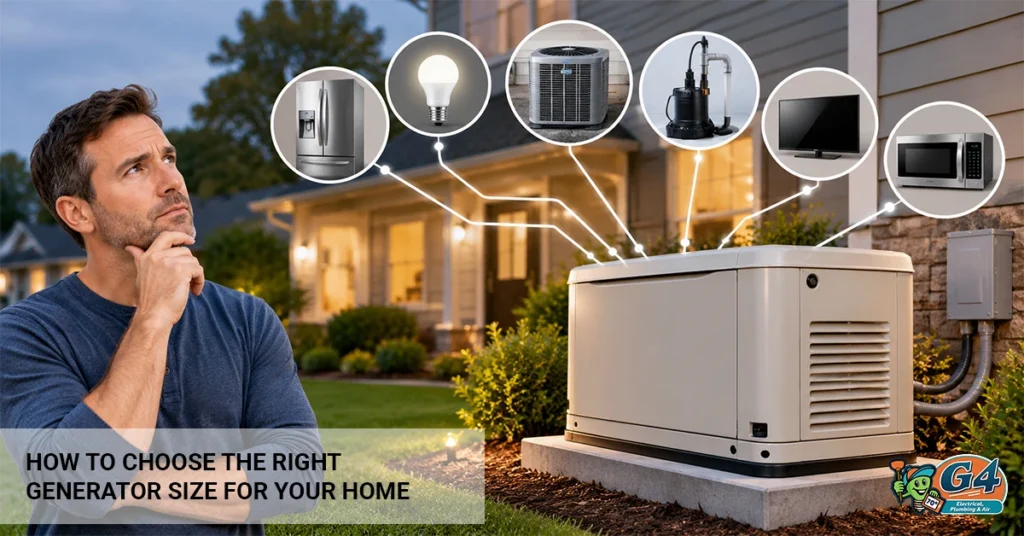
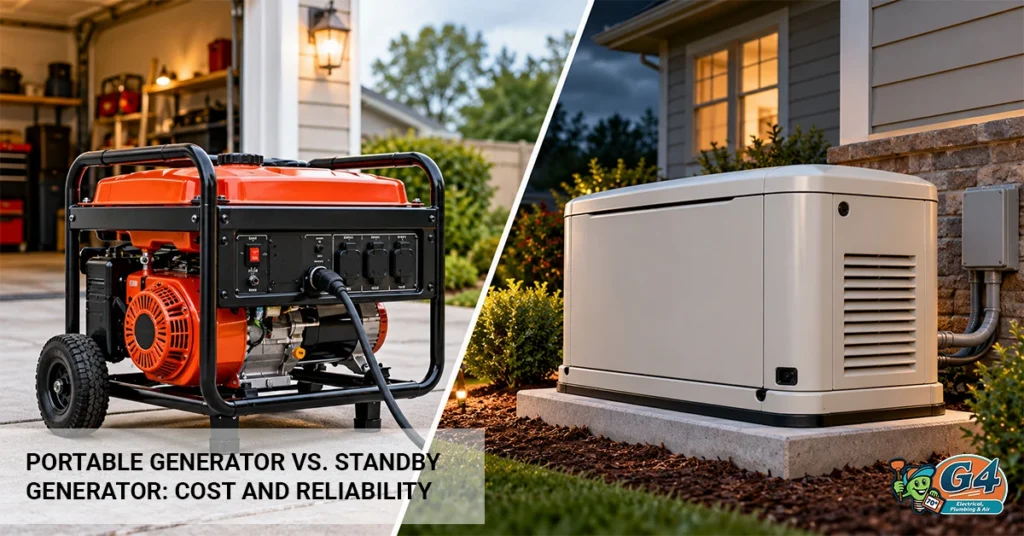
A portable generator costs less upfront and works well for occasional power outages, while a standby generator costs more but provides automatic backup power. The right choice depends on your budget, how often you lose power, and which appliances you need to keep running.
A portable generator requires you to set it up, start it, and refuel it when needed. A standby generator stays installed outside your home and starts automatically when utility power fails, provided the system works correctly.
Both options can provide reliable backup power when properly sized and maintained. If you only need to run a refrigerator, lights, and a few essential appliances, a portable generator may be enough. If you want automatic backup for multiple household circuits, a standby generator may be worth the extra cost.
For professional help choosing and installing a backup power system, explore our home generator installation services.
In this guide, you’ll compare the cost, reliability, fuel use, and maintenance requirements of both generator types to find the best fit for your home.
Portable Generator vs. Standby Generator: What’s the Difference?
The main difference between a portable generator and a standby generator is how you install and operate them. A portable generator provides movable backup power and usually requires manual setup, while a standby generator stays installed outside your home and starts automatically when the power goes out.
Both can keep essential appliances running during an outage. Your choice depends on your budget, power needs, and how much convenience you want.
What Is a Portable Generator?
A portable generator is a movable machine that produces electricity during a power outage. Most residential models run on gasoline, while some use propane or support both fuels.
You set up the generator outdoors, start it, and connect compatible appliances using properly rated outdoor extension cords. If you want to power household circuits, a larger portable generator can connect through a professionally installed transfer switch.
A portable generator can power essential items such as:
- Refrigerators and freezers
- Lights and phone chargers
- Computers and internet routers
- Small kitchen appliances
- Compatible window air conditioners
- Other appliances within its power capacity
The biggest advantage of a portable generator is its lower upfront cost. You can buy one without paying for a permanent installation if you only need to power individual appliances.
However, you must manage the electrical load, monitor fuel levels, and refuel the generator when necessary. You also need to follow the manufacturer’s safety instructions.
Always operate a portable generator outdoors, at least 20 feet from your home, with the exhaust directed away from doors, windows, and vents. Never run it inside a house, garage, or enclosed space.
Review these essential electrical safety tips before connecting or operating backup power equipment.
What Is a Standby Generator?
A standby generator is a permanently installed backup power system that starts automatically when your home’s electricity goes out. Most residential models run on natural gas or liquid propane and connect to your electrical system through an automatic transfer switch.
When the power fails, the transfer switch detects the outage and signals the generator to start. Once the generator is ready, the switch transfers the connected circuits to backup power. When utility power returns, the system switches back.
Depending on its size, a standby generator can power a few essential circuits or much of your home. A properly sized system may run your refrigerator, lights, heating equipment, and central air conditioner.
The biggest advantage of a standby generator is convenience. You don’t need to move it into position, start it manually, or refill a portable fuel tank. However, the system still needs regular maintenance and a reliable fuel supply.
A standby generator is a good choice if your home experiences frequent power outages or you want backup power while you’re asleep or away from home.
Portable Generator vs. Standby Generator: Key Differences
A portable generator costs less and requires more hands-on operation, while a standby generator costs more but provides automatic backup power. Here’s how the two compare.
| Feature | Portable Generator | Standby Generator |
| Purchase cost | Usually lower | Usually higher |
| Installation | Minimal for direct appliance connections; more for home circuits | Permanent professional installation |
| Starting method | Usually manual | Automatic |
| Common fuel | Gasoline or propane | Natural gas or propane |
| Power capacity | Varies by model | Varies by model |
| Whole-home backup | Possible with suitable capacity and load management | Possible with suitable capacity and installation |
| Fuel supply | Usually requires manual refueling | Depends on the fuel source and availability |
| Portability | Can be moved | Permanently installed |
| Maintenance | Often handled by the owner | Regular servicing is recommended |
| Best for | Occasional outages and essential appliances | Frequent outages and automatic backup |
Neither generator type is always more reliable than the other. A well-maintained portable generator can perform dependably, while a standby generator can fail if it has a faulty battery, fuel supply problem, or maintenance issue.
Choose a portable generator if you want affordable backup for a few essential appliances. Choose a standby generator if you prefer automatic operation and need backup power for multiple household circuits.
How Much Does a Portable Generator Cost?
A portable generator typically costs between $400 and $2,700 or more in the U.S., depending on its power output, fuel type, and features. You should also budget for fuel, maintenance, and any electrical work needed to connect it safely to your home.
The total cost depends on how much power you need and how often you plan to use the generator. A small model may be enough for a few essential appliances, while a larger unit costs more but can power additional equipment.
Portable Generator Purchase Price
A portable generator’s price mainly depends on its power capacity, features, and fuel type. Here’s what you can expect to pay for different sizes.
| Portable Generator Type | Estimated Purchase Cost |
| Small generator for essential devices | 400–800 |
| Mid-size home backup generator | 800–1,500 |
| Larger portable generator | 1,500–2,700+ |
These are approximate U.S. prices, not fixed quotes. Actual prices vary by brand, model, and location.
A small generator may power your refrigerator, lights, and phone chargers. A larger model can run more appliances, provided it has enough capacity.
Before buying, list the appliances you want to use during an outage and check their power requirements. Pay attention to both running watts and starting watts. Appliances with motors, such as refrigerators and air conditioners, often need extra power when they start.
If you choose a generator based only on running wattage, it may struggle to start certain appliances or shut down when the electrical load becomes too high.
The best way to choose the right size is to calculate your total power needs before comparing prices. This helps you avoid paying for more capacity than you need—or buying a generator that can’t handle your essential appliances.
Portable Generator Fuel Costs
Portable generator fuel costs depend on how much fuel the unit uses, how heavily you load it, and how long you run it.
Gasoline is a common fuel for portable generators, but you’ll need to store it safely and keep enough on hand for extended outages. During severe weather, buying more fuel may also become difficult.
Some portable generators run on propane or support both gasoline and propane. These models give you another fuel option, but you still need an adequate supply to keep the generator running.
To estimate your fuel costs, check the manufacturer’s fuel consumption figures at the load you expect to use.
Fuel cost = Fuel used per hour × Operating hours × Price per unit of fuel
For example, if your generator uses 0.5 gallons of gasoline per hour and you run it for 8 hours, you’ll need 4 gallons of fuel. Multiply that amount by your local price per gallon to estimate the cost.
Actual consumption varies by generator model and electrical load, so use the manufacturer’s specifications for a more accurate estimate.
Portable Generator Maintenance and Repair Costs
Portable generator maintenance costs depend on the model, how often you use it, and whether you perform routine maintenance yourself.
Common expenses include:
- Engine oil: Many generators need periodic oil changes.
- Air filters and spark plugs: These require inspection and replacement according to the manufacturer’s schedule.
- Fuel-system maintenance: Old fuel can cause starting problems and may require cleaning or repairs.
- Starting batteries: Electric-start models may eventually need a replacement battery.
- Repairs and replacement parts: Mechanical or electrical faults can add to your long-term costs.
You can often handle basic maintenance yourself by following the owner’s manual. More complex problems may require a qualified technician.
Don’t leave your generator unmaintained between outages. Stale fuel, a weak battery, or dirty components can prevent it from starting when you need it most.
Additional Costs for Connecting a Portable Generator to Your Home
Connecting a portable generator to your home can add to the total cost, especially if you want to power household circuits rather than individual appliances.
For compatible appliances, properly rated outdoor extension cords may be enough. If you want to power selected household circuits, you may need a transfer switch, an outdoor generator inlet, wiring, and professional installation.
A qualified electrician can help determine the right setup through professional electrical installation services.
Permit requirements and installation costs vary by location and electrical system.
Never plug a generator into a regular wall outlet to power your home. This can cause electrical backfeeding, which may injure utility workers and damage equipment. It can also create serious fire and electrocution risks.
Ask a licensed electrician to recommend a safe connection method for your generator and home. The right setup helps protect your household while allowing you to use your backup power safely.
How Much Does a Standby Generator Cost?
A standby generator typically costs $3,500 to $7,000 for the unit alone in the U.S., while a complete installation can exceed $10,000. The final price depends on the generator’s size, your home’s electrical system, the fuel supply, and the work needed to install it.
For a more detailed breakdown of equipment and installation expenses, see our guide to whole-home generator installation costs.
Unlike a portable generator, a standby system needs a permanent outdoor location and a connection to your home’s electrical system. You’ll also need to account for maintenance and fuel costs over time.
These are approximate U.S. price ranges, not guaranteed quotes.
Standby Generator Purchase and Installation Costs
The total cost of installing a standby generator depends on the equipment you choose and how much work your property requires.
Common expenses include:
- Generator unit: The price depends on the generator’s power capacity, features, and fuel type.
- Automatic transfer switch: This switches your home between utility power and generator power.
- Electrical work: Wiring and connections must meet applicable safety requirements.
- Fuel connections: Natural gas piping or a propane supply may be needed.
- Mounting base: The generator needs a suitable, stable installation surface.
- Labor and permits: Installation, inspections, and permits may add to the total.
Your property also affects the price. If your home already has a suitable fuel connection and installation location, the work may be simpler. If you need electrical upgrades, new fuel piping, or extensive site preparation, expect to pay more.
Before buying a generator, ask a qualified installer to assess your home’s power needs and provide an itemized estimate. This helps you understand the full cost before committing.
How Much Do Transfer Switches and Electrical Work Cost?
Transfer switches and electrical work add to the cost of a standby generator, but they’re essential for connecting the system safely to your home.
An automatic transfer switch detects a utility power failure and transfers the designated circuits to generator power once the generator is ready. When utility power returns, it switches the circuits back.
The installer must also make sure the generator can handle the electrical load you plan to run.
For example, a smaller generator may power your refrigerator, lights, and a few essential circuits but struggle to run central air conditioning, an electric water heater, and other high-demand appliances at the same time.
If your home needs a panel upgrade to support additional electrical demand, review our guide to electrical panel upgrade costs.
If you want whole-home backup, ask an electrician to calculate your electrical demand and recommend the right generator capacity. Depending on your home, you may need a larger unit or a load-management system.
Local codes may also set requirements for generator placement, ventilation, noise, fuel connections, and electrical work. Confirm these requirements before installation.
Standby Generator Maintenance Costs
Standby generator maintenance costs depend on the model, operating hours, and service requirements. Regular maintenance helps keep the system ready when your home loses power.
Typical maintenance tasks include:
- Changing engine oil and filters as recommended
- Checking the starting battery
- Inspecting air filters and fuel connections
- Checking electrical connections
- Testing the automatic transfer switch
- Running the generator according to the manufacturer’s schedule
Many standby generators run automatic exercise cycles to check that the engine can start and operate. These tests use some fuel, but they don’t replace scheduled maintenance.
You should also budget for repairs and fuel used during actual outages. Ask the installer about the recommended service schedule and annual maintenance costs before choosing a model.
Fuel availability also affects operating costs. A natural gas generator can run for an extended period if the gas supply remains available. A propane generator depends on the tank’s capacity and how quickly the unit consumes fuel.
For the most accurate estimate, compare the generator’s purchase price, installation, expected fuel use, maintenance, and potential repair costs over the period you plan to own it.
Portable vs. Standby Generator: Total Cost Comparison
A portable generator usually costs less to buy and install, while a standby generator requires a larger upfront investment. However, the cheapest option upfront isn’t always the best value over five to ten years.
To compare both options fairly, include the purchase price, installation, fuel, maintenance, and repairs. You should also consider how often you lose power and how much convenience you need.
| Cost Factor | Portable Generator | Standby Generator |
| Equipment | Usually hundreds to a few thousand dollars | Usually several thousand dollars |
| Installation | Often minimal; home connections add cost | Typically requires professional installation |
| Fuel | Usually purchased and stored separately | Natural gas or propane, depending on the system |
| Maintenance | Oil changes, filters, fuel-system care, and repairs | Scheduled servicing, oil changes, and battery checks |
| Manual effort | Requires setup and monitoring | Usually starts automatically |
| Overall ownership cost | Often lower for occasional use | Higher upfront, with added convenience |
Actual costs depend on the generator model, fuel prices, installation requirements, and how often you use it.
Long-Term Costs Over Five to Ten Years
A portable generator often costs less over five to ten years if you only need backup power during occasional outages. A standby generator costs more upfront, but its automatic operation may justify the expense if your home loses power frequently.
Consider two homeowners.
The first buys a portable generator to power a refrigerator, lights, and a few essential appliances. The initial cost is relatively low, and the owner handles basic maintenance. However, someone must start the generator, monitor its operation, and refuel it when necessary.
The second homeowner installs a standby generator. The initial investment is higher, and the system needs regular servicing. In return, it starts automatically during an outage and can power more household circuits if properly sized.
Neither option is always cheaper over ten years. A portable generator may require less money upfront, while a standby generator may offer greater convenience during frequent or extended outages.
Use this formula to estimate your total ownership cost:
Total ownership cost = Equipment + Installation + Fuel + Maintenance + Repairs
For a useful comparison, estimate how many hours you’ll run the generator each year. Then calculate fuel consumption, scheduled maintenance, and likely repair expenses over your chosen period.
Use local prices and the manufacturer’s fuel consumption figures. This gives you a more realistic estimate than comparing purchase prices alone.
Which Generator Offers Better Value for Money?
A portable generator usually offers better value if you need affordable backup power for a few essential appliances during occasional outages. A standby generator may offer better value if you experience frequent outages or want automatic backup without manually operating a machine.
Choose a portable generator if:
- You have a limited upfront budget.
- Power outages are relatively infrequent.
- You only need to run essential appliances.
- You’re comfortable handling setup, monitoring, and refueling.
Consider a standby generator if:
- Your home experiences frequent or prolonged outages.
- You want the generator to start automatically.
- You need backup power for multiple household circuits.
- You prefer not to handle a portable generator during severe weather or overnight outages.
The best choice depends on more than price. Consider your household’s power needs, fuel availability, safety requirements, and willingness to manage the generator during an outage. A portable unit can be the sensible financial choice, while a standby system may be worth the extra cost for greater convenience and broader backup power.
Which Generator Is More Reliable During a Power Outage?
A standby generator generally provides more reliable backup convenience because it starts automatically when utility power fails. A portable generator can also deliver dependable backup power, but it usually requires someone to start it, connect appliances, and monitor its operation.
Neither generator guarantees uninterrupted electricity. Reliability depends on proper sizing, fuel availability, regular maintenance, safe installation, and equipment condition.
Automatic Starting vs. Manual Operation
Standby generators start automatically when utility power fails, provided the system is working correctly. An automatic transfer switch then connects the generator to the designated electrical circuits.
This feature is especially useful during overnight outages, severe weather, or times when nobody is home. You don’t need to be present to start the generator manually.
Portable generators require more involvement. Someone must position the unit safely, start the engine, connect appliances or an approved home connection, and manage the electrical load. Electric-start models make starting easier, but they still require manual operation.
A standby generator is the better choice for homeowners who want automatic backup power with minimal intervention. A portable generator can still be reliable if someone is available to operate it safely.
Performance During Short and Extended Outages
A portable generator can handle a short power outage by running essential appliances, such as a refrigerator, lights, and selected electronics, as long as its capacity is sufficient.
Extended outages require more planning. Portable generators may need frequent refueling, depending on tank size, electrical load, and fuel consumption. Always follow the manufacturer’s shutdown and cooling instructions before refueling.
Standby generators connected to natural gas can run for extended periods while the gas supply remains available and the unit operates within its limits. Propane-powered standby generators can also provide prolonged backup power if the tank holds enough fuel.
Neither type should be expected to run indefinitely. Both need appropriate maintenance, and extended operation must follow the manufacturer’s requirements.
Fuel Availability and Generator Runtime
Fuel availability directly affects how long a generator can supply backup electricity. The best option depends on your fuel source, expected outage length, and power requirements.
- Portable generators: Gasoline models are common, but you must plan for safe fuel storage and resupply. Fuel shortages during severe storms can interrupt operation. Dual-fuel models may offer additional flexibility if you have an adequate propane supply.
- Natural gas standby generators: A continuous utility gas supply can reduce the need for manual refueling. However, gas service may not remain available during every emergency.
- Propane standby generators: These systems can run for extended periods when the tank contains enough fuel. Runtime depends on tank capacity, generator size, and electrical load.
Before choosing a generator, check its expected fuel consumption at the load you intend to run. A generator powering several major appliances will generally consume more fuel than one supplying only essential circuits.
Reliability During Severe Weather
A properly installed standby generator can provide dependable backup power during storms, but its performance depends on the installation site and surrounding conditions.
Flooding, falling branches, debris, and blocked ventilation can affect operation. The generator must be installed according to the manufacturer’s instructions and applicable local requirements.
Portable generators need extra care during severe weather because they must be positioned correctly each time they are used. Never operate one in a garage, basement, shed, or other enclosed or partially enclosed space. Generator exhaust contains carbon monoxide, a poisonous gas that can cause death.
Keep portable generators outdoors, well away from doors, windows, and air intakes. Follow the manufacturer’s instructions for wet-weather operation, and never use a cover or enclosure that traps exhaust or causes overheating.
What Happens if a Generator Fails to Start?
Both portable and standby generators can fail to start because of a weak battery, stale fuel, low oil, fuel-system problems, or mechanical faults. Standby generators can also experience problems with their automatic starting or transfer systems.
Reduce the risk of failure with these maintenance steps:
- Follow the manufacturer’s maintenance schedule.
- Test the generator at the recommended intervals.
- Check fuel levels, fuel quality, and the starting battery.
- Investigate warning lights, error codes, leaks, or unusual noises.
- Arrange professional servicing when needed.
- For standby systems, test the automatic transfer switch as recommended by the manufacturer.
If you suspect a problem with your home’s electrical system or generator connection, explore our electrical repair services.
Automatic starting does not eliminate the need for maintenance. Regular testing and timely repairs help both generator types remain ready when an outage occurs.
Overall, a standby generator offers greater convenience during unexpected outages, while a portable generator can provide dependable backup at a lower upfront cost. Your best choice depends on how often outages occur, how much power you need, and whether you want automatic operation.
Portable vs. Standby Generator: Maintenance Requirements
Both portable and standby generators need regular maintenance to operate reliably during a power outage. Portable generators typically require more hands-on care from the owner, while standby generators often follow a scheduled service plan.
The right maintenance routine depends on the generator model, fuel type, operating hours, and manufacturer’s recommendations.
Portable Generator Maintenance Checklist
Regular inspections help keep a portable generator ready for the next outage. Follow the owner’s manual for maintenance intervals and model-specific requirements.
Use this checklist to maintain your portable generator:
- Check engine oil: Inspect the oil level before use and change it at the recommended intervals.
- Inspect the air filter: Clean or replace it as directed to maintain proper airflow.
- Check the spark plug: Inspect and replace it when required by the maintenance schedule.
- Maintain fresh fuel: Follow the manufacturer’s fuel-storage recommendations to reduce problems caused by stale gasoline.
- Inspect the battery: If your generator has electric start, check the battery and connections.
- Test the generator: Run it at the intervals specified in the owner’s manual.
- Inspect cables and connections: Look for damaged insulation, loose connections, or signs of wear.
- Store it properly: Keep the generator in a dry, suitable location when it is switched off and cool, following the manufacturer’s storage instructions.
Never refuel a running or hot gasoline generator. Shut it down and allow it to cool as directed by the manufacturer before adding fuel. Always operate it outdoors to prevent carbon monoxide poisoning.
Standby Generator Maintenance Schedule
Standby generators typically include automatic exercise cycles and may provide maintenance alerts. These features help confirm that the unit is operating, but they do not replace scheduled servicing.
Common maintenance tasks include:
- Changing engine oil and filters.
- Inspecting the starting battery and electrical connections.
- Checking fuel lines and connections for leaks or damage.
- Inspecting the air filter and other serviceable components.
- Testing the automatic transfer switch according to the manufacturer’s instructions.
- Checking for warning lights, error codes, and unusual operating conditions.
Follow the manufacturer’s service schedule and hire a qualified technician for inspections or repairs that require specialist knowledge. Proper servicing helps identify potential problems before the next power outage.
How Maintenance Affects Reliability and Lifespan
Regular maintenance improves generator reliability and can help extend its useful life. However, a well-maintained portable generator may perform better than a neglected standby unit, so generator type alone does not determine reliability.
Several factors affect how long a generator lasts:
- Maintenance history: Regular servicing helps prevent avoidable wear and operating problems.
- Operating hours: Frequent or prolonged use increases the need for maintenance.
- Fuel condition: Improperly stored fuel can cause starting and fuel-system problems.
- Installation and sizing: Correct installation and adequate capacity help prevent operating issues.
- Product quality: Engine design, component quality, and manufacturer support can affect long-term performance.
If you want dependable backup power, choose a generator that matches your household’s needs and follow its maintenance schedule. A standby generator offers automatic operation, while a portable model can provide reliable backup with proper care and regular testing.
Pros and Cons of Portable and Standby Generators
Portable and standby generators offer different benefits depending on your budget, backup power needs, and how often outages occur. Portable generators cost less upfront and offer flexibility, while standby generators provide automatic operation and greater convenience during power interruptions.
Advantages and Disadvantages of Portable Generators
Portable generators are a practical choice for homeowners who need affordable backup power for essential appliances or occasional outages.
Advantages
- Lower upfront cost: Portable generators generally cost less to purchase than standby systems.
- Easy to move: You can transport a portable generator for suitable outdoor activities or use it at different locations.
- Good for essential appliances: Depending on its capacity, a portable model can power refrigerators, lights, fans, and selected electronics.
- Flexible fuel options: Some models run on gasoline, propane, or both.
- Simpler setup for direct connections: You can connect compatible appliances directly without permanent home wiring, provided you follow the manufacturer’s safety instructions.
Disadvantages
- Manual operation: Most portable generators require someone to position and start the unit.
- Refueling and monitoring: You may need to check fuel levels and refuel during extended outages.
- Limited power capacity: Smaller models may not run central air conditioning, electric water heaters, or multiple high-demand appliances at once.
- Fuel storage requirements: Gasoline and other fuels must be stored and handled safely.
- Noise and exhaust: Portable generators can be noisy and produce dangerous carbon monoxide, so they must operate outdoors and away from openings into the home.
Advantages and Disadvantages of Standby Generators
Standby generators are designed for permanent installation and automatic backup power. They are especially useful for households that experience frequent outages or need electricity without manual intervention.
Advantages
- Automatic starting: The system can start when utility power fails, provided the generator and transfer switch are functioning correctly.
- Greater power capacity: A properly sized unit can support multiple circuits or an entire home, depending on the electrical load and system design.
- No manual positioning: The generator remains installed in its designated outdoor location.
- Extended operation: Natural gas or an adequately supplied propane system can support prolonged operation, subject to operating limits and fuel availability.
- Convenience during frequent outages: Automatic operation reduces the need to start the generator manually whenever the power goes out.
Disadvantages
- Higher upfront cost: Equipment, installation, electrical work, and fuel connections can make standby systems significantly more expensive.
- Permanent installation: The unit needs a suitable outdoor location that meets manufacturer instructions and local requirements.
- Ongoing maintenance: Regular inspections and servicing are necessary to keep the system ready.
- Possible additional installation work: Some homes need electrical upgrades, fuel-line modifications, permits, or other site preparations.
- Limited portability: A standby generator is not designed to move easily if you relocate.
Ultimately, a portable generator is often the better fit for occasional outages and tighter budgets. A standby generator is generally better for frequent power interruptions, larger backup power needs, and homeowners who prefer automatic operation.
Which Generator Is Best for Your Home?
The best generator for your home depends on your budget, electricity needs, how often power outages occur, and whether you want automatic backup power. A portable generator usually suits occasional outages and smaller budgets, while a standby generator is often better for frequent outages and larger backup power needs.
Best Generator for a Tight Budget
A portable generator is usually the best choice if you need affordable backup power for essential appliances, such as a refrigerator, lights, fans, and phone chargers.
Before buying, choose a model with enough running and starting wattage for the appliances you plan to use. Also consider fuel availability, noise levels, maintenance costs, and safe fuel storage.
You don’t necessarily need the largest generator available. A properly sized model that meets your essential needs can help you avoid unnecessary upfront costs.
Best Generator for Essential Household Circuits
A portable generator can power selected household circuits when connected through a professionally installed transfer switch or another approved connection system.
This setup can provide power to essential circuits, such as selected lights, refrigeration, and other compatible equipment, without the expense of a permanent standby generator.
However, you must manage the electrical load carefully. Never connect a generator to household wiring through a regular wall outlet or use an arrangement that can send electricity back into utility lines. Have a qualified electrician install the appropriate connection equipment.
Best Generator for Frequent Power Outages
A standby generator is often the best option for homes that experience frequent power outages and need backup electricity with minimal manual effort.
The system detects a utility power failure and starts automatically when functioning correctly. This is especially useful when outages occur overnight, while you’re away from home, or when nobody is available to operate a portable generator.
A standby generator costs more upfront, but its automatic operation can make it a worthwhile investment for households that rely on consistent access to electricity.
Best Generator for Whole-Home Backup Power
A properly sized standby generator is often the most convenient choice if you want to power several major appliances or support most of your home’s electrical needs during an outage.
However, not every standby generator can run every appliance simultaneously. Central air conditioning, electric water heaters, ovens, and other high-demand equipment can place significant demands on the system.
Before choosing a model, have a qualified professional calculate your home’s electrical load. They can determine the required generator capacity and whether load management is needed to operate selected appliances efficiently.
You can also consider whole-house surge protection to help protect compatible household equipment from damaging voltage surges.
Best Generator for Homes With Medical Equipment
Homes that rely on electrically powered medical equipment need a carefully planned backup power system. The right choice depends on the equipment’s power requirements and whether even a brief interruption could create a safety risk.
An automatic standby generator can reduce the need for someone to set up a portable generator during an outage. However, it still takes time to start and transfer power, so it does not guarantee uninterrupted electricity.
If medical equipment cannot tolerate a power interruption, a suitable uninterruptible power supply (UPS) or another approved backup arrangement may be necessary. Consult the equipment manufacturer and healthcare provider, and ask a qualified electrician to assess the electrical requirements.
Important: If the equipment is life-sustaining, do not rely on a generator as the only backup plan unless the arrangement has been confirmed as appropriate for that equipment and situation.
Portable vs. Standby Generator: Which Should You Choose?
Choose a portable generator if you want affordable backup power for essential appliances during occasional outages. Choose a standby generator if you need automatic operation, experience frequent power interruptions, or want to power more household circuits.
The right choice depends on your home’s electricity needs, budget, fuel options, and how much involvement you can manage during an outage.
Before buying, ask yourself these five questions.
1. How Often Does Your Power Go Out?
If outages are rare and usually short, a portable generator may provide all the backup power you need. It costs less upfront and can run essential appliances when utility service fails.
If outages happen frequently or last for several hours or days, a standby generator may be more convenient. It can start automatically when utility power fails, provided the system is functioning correctly and fuel is available.
2. What Do You Need to Keep Running?
Make a list of the appliances you want to power during an outage. These might include a refrigerator, lights, fans, a sump pump, or heating and cooling equipment.
Check each appliance’s running wattage and starting wattage. Some equipment, especially appliances with electric motors, needs extra power when starting.
Add up the loads you expect to run simultaneously. This will help you choose a generator with sufficient capacity and avoid overloading it.
If your home’s breakers trip frequently when appliances operate together, read our guide on why a circuit breaker keeps tripping.
3. What Is Your Budget?
A portable generator generally costs less to purchase and may require less installation work, especially when connecting compatible appliances directly.
A standby generator requires a larger initial investment because the total cost may include the unit, permanent installation, electrical work, fuel connections, and permits.
Compare the total cost of ownership, not just the purchase price. Include fuel, routine maintenance, repairs, and any installation upgrades needed for your home.
4. Will Someone Be Home During an Outage?
A portable generator usually requires someone to position it safely, start it, connect the loads, monitor its operation, and refuel it when necessary.
A standby generator can start automatically and transfer power to designated circuits when the system works correctly. This is useful during overnight outages or when nobody is home.
If you cannot reliably operate a portable generator during an emergency, a standby system may be the more practical option.
5. Which Fuel Sources Are Available?
Fuel availability affects both generator choice and runtime.
- Gasoline: Common for portable generators, but safe storage and resupply require planning.
- Propane: Available for some portable and standby models. Runtime depends on the amount of fuel available and the generator’s consumption.
- Natural gas: Can be convenient for compatible standby generators when a reliable utility supply is available.
Check the generator’s fuel consumption at your expected electrical load. Also consider whether you can obtain enough fuel during a prolonged outage.
Before purchasing either generator type, have a qualified electrician assess your electrical requirements and recommend a safe connection method. The best generator is one that provides enough power for your needs, fits your budget, and can be operated safely when an emergency occurs.
Frequently Asked Questions
Is a portable generator cheaper than a standby generator?
Yes. A portable generator generally costs much less upfront than a standby system. Depending on its capacity and features, a portable model may cost hundreds to a few thousand dollars. A standby generator can cost several thousand dollars for the equipment alone, with installation adding to the total.
Actual prices depend on generator size, fuel type, installation requirements, and local labor costs. Compare the full purchase and operating costs before deciding.
Which generator lasts longer?
A generator’s lifespan depends on its build quality, operating hours, maintenance history, and working conditions. Standby generators are designed for permanent backup installations, while portable generators vary in durability and intended use.
Neither type automatically lasts longer in every situation. Compare the manufacturer’s expected service life, warranty, maintenance requirements, and guidance for extended operation.
Can a portable generator power an entire house?
Some large portable generators can power multiple household circuits, but whether they can supply an entire home depends on their output, the home’s electrical demand, and how loads are managed.
You will need an appropriately rated transfer switch or another approved connection system installed by a qualified electrician. Smaller portable generators are generally better suited to essential appliances rather than the entire home.
Is a standby generator worth the extra cost?
A standby generator may be worth the extra cost if your home experiences frequent outages, you need automatic backup power, or you want to operate several household circuits without manually setting up a generator.
If outages are occasional and you only need to run a refrigerator, lights, and a few other appliances, a portable generator may offer better value for money.
How long can a standby generator run continuously?
A standby generator’s runtime depends on its model, electrical load, fuel supply, and operating requirements. A natural-gas-powered unit may run for an extended period if the gas supply remains available. A propane-powered model depends on tank capacity and fuel consumption.
Continuous operation is not unlimited. Follow the manufacturer’s instructions for maintenance, oil changes, inspections, and maximum operating requirements.
How often should a home backup generator be serviced?
Follow the maintenance schedule in your generator’s owner’s manual. Service intervals vary by model, fuel type, and operating hours.
Both portable and standby generators need routine inspections and maintenance. A generator that runs frequently during a prolonged outage may require servicing sooner than one used occasionally. Check the manual for the correct service intervals rather than relying on a universal schedule.
Which generator is safer during a power outage?
Both portable and standby generators can be operated safely when installed and used correctly. However, both fuel-burning generator types can produce deadly carbon monoxide, an odorless, colorless gas.
Follow these essential safety precautions:
- Operate portable generators outdoors, at least 20 feet from the home, with exhaust directed away from doors, windows, and vents.
- Never operate a portable generator in a garage, basement, shed, or other enclosed or partially enclosed space.
- Install and maintain carbon monoxide alarms inside the home according to the manufacturer’s instructions and local requirements.
- Keep generators away from standing water and follow the manufacturer’s instructions for wet-weather operation.
- Have standby generators installed and serviced according to manufacturer instructions and applicable local codes.
A standby generator reduces the need for manual setup, but it still requires proper installation and maintenance. Safe operation matters regardless of which type you choose.
Final Thoughts
Choosing between a portable generator and a standby generator depends on your budget, backup power needs, and how much convenience you want during an outage.
A portable generator is usually the better choice for affordable backup power during occasional outages. It can keep essential appliances running without the higher upfront cost of a permanent system. A standby generator costs more but offers automatic operation and can power multiple household circuits when properly sized.
Before buying, compare equipment and installation costs, calculate your electrical load, check fuel availability, and consider ongoing maintenance. Make sure the generator can be installed and operated safely.
The best generator is one that provides enough power for your household, fits your budget, and meets your backup needs when the electricity goes out.