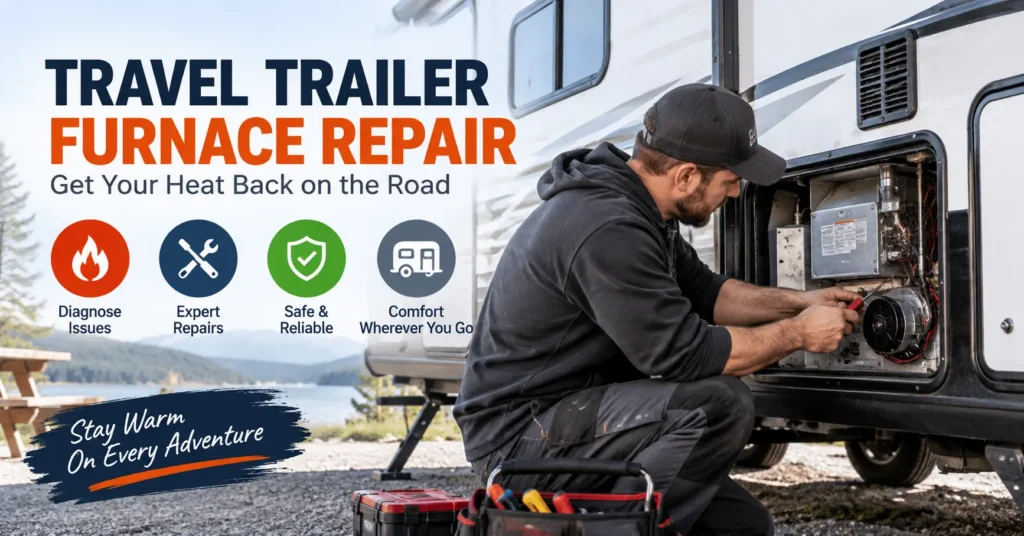
A travel trailer furnace that stops working is often caused by a simple problem with power, propane, the thermostat, airflow, or the ignition system. Some issues are easy to check yourself, while others require professional furnace repair.
If your furnace won’t turn on, blows cold air, keeps shutting off, or runs without producing heat, start with the basics. Check the thermostat, 12-volt power supply, propane level, fuse, and furnace vents before assuming a major component has failed.
This travel trailer furnace repair guide covers the most common problems, quick troubleshooting steps, and signs that it is time to call a professional.
Is Your Travel Trailer Furnace Not Working?
Most travel trailer furnace problems are caused by 12V power issues, thermostat problems, interrupted propane supply, restricted airflow, or ignition failure.
The symptom your furnace shows can help narrow down the problem.
| Furnace Problem | Possible Cause | What to Check First |
| Furnace does nothing | Power or thermostat issue | Battery, fuse, thermostat |
| Blower runs but no heat | Propane or ignition problem | Propane supply and ignition |
| Furnace blows cold air | Burner isn’t staying lit | Propane and burner operation |
| Starts then shuts off | Airflow or safety switch issue | Vents, airflow, sail switch |
| Keeps cycling | Overheating or airflow problem | Vents and ductwork |
| Weak airflow | Restricted or damaged ducts | Registers and ducts |
| Strange noises | Blower or mechanical problem | Furnace and blower area |
Start with the simplest checks. You may be able to find the problem without taking the furnace apart.
Common Travel Trailer Furnace Problems and Quick Fixes
The most common travel trailer furnace problems involve power, propane, ignition, airflow, or furnace safety controls. Here is what different symptoms can tell you.
1. Travel Trailer Furnace Won’t Turn On
If your travel trailer furnace won’t turn on at all, check the thermostat and 12V electrical supply first.
Set the thermostat to heat and raise the temperature above the current temperature inside the trailer. If nothing happens, check whether the trailer has adequate 12V power.
Next, inspect the furnace fuse and any accessible furnace power switch. A blown fuse, weak battery, loose electrical connection, or thermostat problem can prevent the furnace from starting.
Try these basic checks:
- Make sure the thermostat is set to heat.
- Raise the thermostat temperature.
- Check the 12V battery charge.
- Inspect the furnace fuse.
- Make sure the furnace power switch is on, if equipped.
- Look for obviously loose or damaged wiring without touching exposed electrical connections.
If the furnace still does nothing, the problem may involve the thermostat, control board, blower motor, wiring, or another internal component.
2. Furnace Blower Runs but There Is No Heat
If the blower runs but the furnace produces no heat, the burner may not be receiving propane or completing the ignition sequence.
Start by checking your propane supply. Make sure there is propane in the tank and that the appropriate valve is open.
A travel trailer furnace normally uses the blower as part of its startup process. The blower may therefore run even when the burner fails to ignite.
Possible causes include:
- Empty or low propane supply
- Closed propane valve
- Propane flow or pressure problem
- Ignition failure
- Dirty burner components
- Faulty sail switch
- Control board problem
- Gas valve problem
If other propane appliances also aren’t operating correctly, the issue may extend beyond the furnace itself.
Do not repeatedly attempt to ignite a furnace when you smell propane. Turn the system off and have the propane system checked.
3. Travel Trailer Furnace Blows Cold Air
A travel trailer furnace may blow cold air when the blower works but the burner fails to ignite or stay lit.
First, confirm that propane is available. Then listen to what happens after the blower starts.
If you hear the furnace attempting to ignite but never feel warm air, there could be an ignition, burner, propane, or safety-control problem.
Restricted airflow can also contribute to furnace problems. If the furnace gets too hot, a safety control may shut the burner down while the blower continues running.
Check that:
- Interior heat registers are open.
- Return-air openings are not blocked.
- Exterior furnace vents are clear.
- Propane is available.
- Nothing is obstructing airflow around the furnace.
If the burner repeatedly attempts to ignite and fails, professional diagnosis is usually the safer next step.
4. Furnace Starts but Shuts Off Quickly
A travel trailer furnace that starts and then shuts off may have restricted airflow, an ignition problem, or an issue with a safety control.
This behavior is often described as short cycling.
Check the exterior intake and exhaust openings for obvious obstructions. Dirt, debris, insects, or other material around the furnace openings can interfere with normal operation.
Also check the interior vents and return-air area. Blocking airflow can cause the furnace to overheat and trigger a safety shutdown.
Two components that may be involved are the sail switch and limit switch.
The sail switch helps confirm that the blower is moving enough air for safe burner operation. The limit switch helps protect the furnace from excessive temperatures.
If either component is malfunctioning, or if airflow conditions prevent it from operating normally, the furnace may shut down.
Never bypass a furnace safety switch to keep the system running.
5. Furnace Has Weak or Uneven Airflow
Weak furnace airflow is often caused by blocked registers, restricted return air, damaged ducts, or a blower problem.
Walk through your trailer and check every heat register. Make sure they are open and not covered by furniture, bags, bedding, or other items.
Then inspect any accessible ductwork.
Travel trailer ducts can become:
- Crushed
- Disconnected
- Loose
- Restricted
- Damaged
A disconnected duct can also send heated air into an enclosed area instead of the living space.
If all accessible vents and ducts look normal but airflow remains weak, the blower or another internal furnace component may need inspection.
6. Furnace Makes Strange Noises
Unusual furnace noises can indicate loose components, blower problems, debris, or mechanical wear.
Pay attention to when the noise occurs.
Rattling may come from a loose panel or component. Squealing can point toward a blower motor or moving part. Repeated clicking may be associated with the furnace attempting to ignite.
A sudden new noise is more important than a sound the furnace has always made.
Turn the furnace off and arrange an inspection if you hear loud grinding, scraping, repeated abnormal ignition sounds, or another noise that suggests a mechanical problem.
Quick Travel Trailer Furnace Troubleshooting Checklist
The quickest way to troubleshoot a travel trailer furnace is to check the thermostat, 12V power, propane, airflow, and exterior vents before investigating internal components.
Follow these steps in order:
- Set the thermostat to heat.
- Raise the thermostat above the current indoor temperature.
- Check the trailer’s 12V power supply.
- Inspect the furnace fuse.
- Confirm that you have propane.
- Make sure the appropriate propane valve is open.
- Check exterior furnace intake and exhaust openings.
- Make sure interior heat registers are open.
- Make sure return-air openings are not blocked.
- Reset the furnace only if the manufacturer’s instructions provide a safe reset procedure.
- Run the furnace again and observe what happens.
Pay attention to the sequence.
Start by identifying what the furnace is doing. Does nothing happen, or does the blower start? Does the furnace attempt ignition, or does it produce heat for a few seconds before shutting down?
Those details can make the actual problem much easier to diagnose.
Stop troubleshooting if you smell propane, see signs of overheating or damaged wiring, or suspect a combustion-related problem.
Why Does a Travel Trailer Furnace Keep Shutting Off?
A travel trailer furnace that keeps shutting off may have an airflow restriction, propane problem, ignition failure, overheating condition, or faulty safety component.
Start by checking the easiest possibilities.
Make sure heat registers and return-air openings are clear. Check the exterior intake and exhaust openings for debris. Confirm that the propane supply is adequate.
If the furnace starts normally but shuts down shortly afterward, possible causes can include:
- Restricted airflow
- Blocked furnace vents
- Low or inconsistent propane supply
- Burner or ignition problems
- Dirty furnace components
- Sail switch problems
- Limit switch problems
- Control board issues
- Blower problems
Repeated short cycling should not be ignored. The furnace may be shutting itself down because a safety condition is not being met.
Can You Repair a Travel Trailer Furnace Yourself?
You can perform basic travel trailer furnace troubleshooting yourself, but repairs involving propane, combustion, internal wiring, gas valves, burners, or safety controls should be handled by a qualified professional.
Safe basic checks generally include checking the thermostat, battery, fuse, propane supply, registers, and visible exterior vents.
You may also inspect accessible areas for obvious debris or disconnected ductwork.
Avoid DIY repairs that require you to modify or bypass furnace safety systems.
In particular, don’t bypass a sail switch or limit switch simply to make the furnace operate. These components are there to prevent unsafe operating conditions.
Professional diagnosis is the better option when the issue involves:
- Propane lines or fittings
- Gas valves
- Burners
- Ignition components
- Internal electrical components
- Control boards
- Safety switches
- Persistent overheating
- Repeated ignition failure
A quick DIY fix is not worth creating a propane, fire, electrical, or carbon monoxide hazard.
How Much Does Travel Trailer Furnace Repair Cost?
Travel trailer furnace repair cost depends on the failed component, furnace design, labor required, parts availability, and how difficult the furnace is to access.
A simple electrical connection or airflow problem may require much less work than replacing a blower motor, gas valve, or control board.
Common repairs can involve:
| Repair Area | What May Be Needed |
| Thermostat | Testing, wiring repair, or replacement |
| Sail switch | Cleaning, diagnosis, or replacement |
| Limit switch | Diagnosis or replacement |
| Ignition system | Cleaning, adjustment, or component replacement |
| Blower motor | Repair or replacement |
| Control board | Testing or replacement |
| Gas valve | Professional diagnosis and replacement |
| Ductwork | Reconnection, sealing, or repair |
The final cost can also depend on the furnace brand and model, local labor rates, diagnostic time, and whether replacement parts are readily available.
For that reason, a proper diagnosis should come before replacing parts.
Replacing components based only on symptoms can quickly become more expensive than finding the actual cause first.
When Should You Stop Troubleshooting and Call a Professional?
You should call a professional when the furnace has a propane, combustion, electrical, overheating, or repeated ignition problem that basic troubleshooting does not resolve.
Stop using the furnace and get professional help if:
- You smell propane.
- The furnace repeatedly fails to ignite.
- You notice damaged electrical wiring.
- The furnace repeatedly overheats or shuts down.
- The burner does not operate normally.
- The furnace makes loud grinding or mechanical noises.
- A fuse repeatedly blows.
- You suspect a gas valve or control board problem.
- The furnace still doesn’t work after basic checks.
A professional can test the system instead of replacing parts based on guesswork. Recognizing common furnace repair signs can help you know when professional service is necessary.
That is especially important with propane furnaces because several safety controls must work correctly before the burner can operate.
Travel Trailer Furnace Repair vs. Replacement
Repair usually makes sense when the furnace has one repairable problem and the rest of the system is still in good condition.
A failed switch, thermostat, ignition component, or blower-related part does not automatically mean you need a new furnace.
Replacement may make more sense when the furnace has multiple major problems, extensive damage, recurring breakdowns, or parts that are difficult to obtain.
Consider these factors:
- Furnace age
- Overall condition
- Frequency of previous repairs
- Cost of the current repair
- Availability of replacement parts
- Condition of major furnace components
- Reliability needed for future travel
If the repair is substantial, compare the complete repair estimate with the cost and expected service life of replacement before deciding.
How to Prevent Travel Trailer Furnace Problems
Regular inspection and keeping the furnace airflow path clear can prevent many common travel trailer furnace problems.
Before a long trip or cold-weather camping season:
- Check furnace operation.
- Keep heat registers open and clear.
- Keep return-air openings unobstructed.
- Inspect exterior intake and exhaust openings.
- Check accessible ductwork.
- Maintain your trailer’s battery system.
- Make sure the propane system is operating correctly.
- Address unusual noises or short cycling early.
It is much easier to deal with a furnace problem before leaving home than during a freezing night at a campsite.
What Should You Do First When Your Travel Trailer Furnace Stops Working?
When your travel trailer furnace stops working, first check the thermostat, 12V power, fuse, propane supply, and airflow.
These simple checks can rule out many common causes without taking the furnace apart.
When the blower works but you have no heat, focus on propane and ignition. A furnace that starts but quickly shuts down may have airflow restrictions or safety-control issues.
If those checks don’t solve the problem, avoid guessing or replacing random parts. A proper furnace diagnosis can identify the failed component and determine whether repair or replacement makes more sense.
Need Travel Trailer Furnace Repair?
If your travel trailer furnace won’t start, blows cold air, keeps shutting off, or isn’t heating properly, professional diagnosis can help find the actual problem and get your heating system working safely again.
A qualified technician can inspect the electrical system, airflow, ignition components, safety controls, burner, and propane-related components to determine what is causing the failure.
Don’t wait until your next cold-weather trip to find out the furnace still isn’t working.
Contact G4 Electrical, Plumbing & Air today to schedule travel trailer furnace repair and get your heating system checked by a professional.
[Schedule Travel Trailer Furnace Repair]
FAQs About Travel Trailer Furnace Repair
Why is my travel trailer furnace not working?
A travel trailer furnace may stop working because of a thermostat problem, weak 12V power, blown fuse, propane supply issue, restricted airflow, ignition failure, or faulty furnace component. Start with the thermostat, battery, fuse, propane, and vents.
Why does my RV furnace blow cold air?
An RV furnace may blow cold air when the blower operates but the burner fails to ignite or stay lit. Check the propane supply and airflow first, then have the ignition and furnace safety components inspected if the problem continues.
Why does my travel trailer furnace keep shutting off?
A travel trailer furnace may keep shutting off because of restricted airflow, overheating, propane problems, ignition failure, or a problem with a sail switch, limit switch, blower, or control board. Repeated shutdowns should be diagnosed rather than ignored.
Why does my RV furnace blower run but there is no heat?
If the RV furnace blower runs but there is no heat, the burner may not be receiving propane or completing the ignition sequence. Confirm propane availability first and seek professional diagnosis if the burner repeatedly fails to ignite.
How do I reset my travel trailer furnace?
The correct reset procedure depends on the furnace model, so follow the instructions provided by the furnace manufacturer. Avoid repeatedly cycling the furnace if it fails to ignite, and never bypass a safety component to force it to run.
How long do travel trailer furnaces last?
Travel trailer furnace lifespan varies based on furnace design, usage, maintenance, storage conditions, and the condition of individual components. Age alone should not determine whether a furnace needs replacement; its overall condition and repair history matter more.
Is it safe to repair an RV propane furnace myself?
Basic troubleshooting such as checking the thermostat, fuse, battery, propane supply, and clear vents can be reasonable for an owner, but internal propane, combustion, electrical, and safety-control repairs should be performed by a qualified professional.