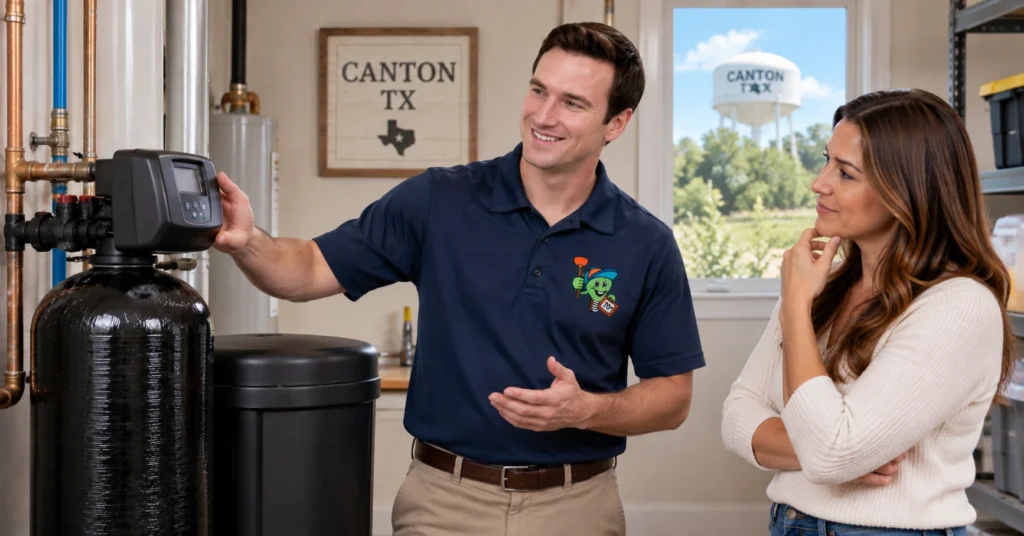
A water softener may help if hard water is causing mineral buildup, water spots, or other problems in your Canton, TX home. But not every home needs one.
The best way to know is to test your home’s water. Water hardness can vary based on your water source and other local factors. A water test can show whether hard water is actually causing the problems you’re seeing and whether a softener is worth considering.
What Is Hard Water?
Hard water is water that contains higher levels of minerals such as calcium and magnesium. These minerals occur naturally in water and do not necessarily mean the water is unsafe to use.
The problem is that these minerals can leave deposits as water moves through your home’s plumbing. You may notice white or chalky buildup around faucets, showerheads, sinks, and other fixtures.
Hard water can also leave spots on dishes and glassware and make soap harder to lather and rinse away. Over time, mineral scale can build up inside water-using appliances and plumbing components.
If you notice these signs throughout your Canton, TX home, testing the water can help confirm whether hard water is the cause.
Is the Water in Canton, TX Hard?
Water hardness can vary from one Canton, TX home to another, so testing your own water is the best way to know how hard it is.
Your water source can make a difference. A home connected to the municipal water supply may have different water characteristics from a home that uses a private well. Plumbing conditions and other local factors can also affect what you notice at home.
Instead of assuming your water is hard based only on your location, have it tested. A water hardness test can show the mineral level in your water and help you decide whether a water softener is actually needed.
How Do You Know If Your Home Has Hard Water?
You may have hard water if you notice mineral buildup, water spots, or soap that does not lather well around your home. These signs often show up on everyday fixtures and appliances.
Look for:
- White or chalky buildup around faucets
- Spots on glasses and dishes
- Mineral deposits on showerheads
- Soap that is difficult to lather or rinse away
- Residue around sinks and tubs
- Dry-feeling skin after bathing
- Mineral buildup inside water-using appliances
- Scale around plumbing fixtures
One of these signs by itself does not confirm hard water. But if you notice several of them throughout your home, it is worth testing your water.
A water hardness test can confirm whether calcium and magnesium are present at levels that may be causing the buildup and other problems.
What Does a Water Softener Do?
A water softener reduces the calcium and magnesium that cause hard-water scale, helping prevent mineral buildup throughout your home’s plumbing system.
Most traditional water softeners use a process called ion exchange. As hard water passes through the softener, the system removes calcium and magnesium and replaces them with sodium or, in some systems, potassium.
A water softener is not the same as a water filter. A softener is designed mainly to treat hard water, while a filter targets specific particles or contaminants depending on the type of filter used.
If you’re not sure what is causing your water-quality problems, testing your water first can help you choose the right treatment for your Canton, TX home.
Do You Need a Water Softener in Canton, TX?
You may need a water softener if hard water is causing noticeable buildup or other problems with your plumbing, appliances, cleaning, or daily comfort.
A softener may be worth considering if you regularly notice:
- Heavy mineral buildup around fixtures
- Water spots that are difficult to remove
- Scale on faucets and showerheads
- Soap that does not lather well
- Mineral buildup inside water-using appliances
- Hard-water residue throughout the home
If you aren’t seeing these problems, you may not need a water softener. Testing your water first can give you a clearer answer before you spend money on a treatment system.
If your Canton, TX home uses a private well, water testing is especially helpful. Hardness may be only one part of your home’s overall water quality, so testing can help identify whether you need a softener or another type of treatment.
What Are the Benefits of a Water Softener?
A water softener can reduce hard-water scale and make everyday cleaning and maintenance easier.
If your home has hard water, a softener may help with:
- Less scale around faucets and fixtures
- Fewer water spots on glasses and dishes
- Better soap lathering and easier rinsing
- Less mineral buildup in water-using appliances
- Easier cleaning of sinks, tubs, and shower areas
- Less hard-water residue on surfaces
The benefits depend on your home’s water hardness and the condition of your plumbing and appliances. A water softener is designed to treat hardness, so it will not solve every water-quality problem.
If you’re unsure whether hard water is causing the issues you’re seeing, testing your water first can help you decide whether a softener is the right solution.
Can Hard Water Damage Your Plumbing?
Hard water can contribute to mineral scale buildup inside plumbing fixtures and components over time, but it does not automatically mean your pipes are being damaged.
As hard water moves through your plumbing, calcium and magnesium can collect on surfaces and form scale. You may see this buildup around faucets, showerheads, valves, and other water-using fixtures. In some cases, heavy scale can restrict water flow or affect how these components work. If mineral buildup is affecting water flow, it can sometimes contribute to water pressure issues at home.
How much buildup develops depends on your water’s hardness, how much water your household uses, the condition of your plumbing, and how long the plumbing has been exposed to hard water.
If you’re seeing significant scale throughout your Canton, TX home, consider testing your water and having the plumbing checked. Finding the cause early can help you decide whether a water softener or another solution is appropriate.
Can a Water Softener Help Your Water Heater?
A water softener can help reduce the minerals that cause scale buildup in your water heater. By reducing calcium and magnesium in the water, it can help limit new mineral deposits over time.
Scale can collect on parts of a water heater that come into contact with hard water. Hard-water scale can affect the performance of your water heater over time, especially when mineral buildup becomes significant. Heavy buildup may affect heating performance and reduce the system’s efficiency.
However, a water softener does not remove scale that has already built up inside the water heater. Existing deposits may require professional cleaning or other maintenance.
If your water heater produces less hot water, makes unusual noises, or takes longer to heat water, have it inspected. The problem may require cleaning, maintenance, or repair rather than simply installing a water softener.
Water Softener vs. Water Filter: What’s the Difference?
A water softener treats hard water, while a water filter targets specific particles or contaminants. They serve different purposes, so the right choice depends on what’s actually in your water.
| Water Softener | Water Filter |
| Reduces calcium and magnesium | Targets specific particles or contaminants |
| Helps reduce hard-water scale | Removes or reduces substances based on the filter type |
| Commonly uses ion exchange | Uses different filtration methods |
| Designed mainly for water hardness | Designed for specific water-quality concerns |
If you’re dealing with mineral buildup, a water softener may be the right solution. If you’re concerned about a specific contaminant, a filter may be more appropriate.
If you’re not sure what is causing your water problem, test your water first. The results can help you choose the right treatment instead of installing a system you may not need.
What Should You Check Before Buying a Water Softener?
Before buying a water softener, first confirm that hard water is actually causing problems in your home. A few simple checks can help you choose the right system and avoid spending money on treatment you may not need.
1. Test Your Water Hardness
Start with a water hardness test. It can show how much calcium and magnesium are in your water and help determine whether a softener is appropriate.
2. Identify Your Water Source
Find out whether your home uses municipal water or a private well. The water source can affect what testing and treatment your home may need.
3. Look for Signs of Scale
Check faucets, showerheads, sinks, and water-using appliances for recurring white or chalky buildup. These deposits can be a sign of hard water.
4. Consider Your Household Water Usage
Choose a softener with enough capacity for your household’s water needs. A system that is too small may not handle your water demand effectively.
5. Consider Maintenance
Find out what maintenance the system requires before buying it. Some water softeners need regular salt refills, cleaning, and periodic service.
6. Check Your Plumbing
If you already have heavy mineral buildup, consider having your plumbing inspected. A new water softener can help reduce future scale, but it will not automatically remove deposits that have already formed.
Taking these steps before buying a system can help you choose a water softener based on your home’s actual water conditions and needs.
Do Water Softeners Require Maintenance?
Yes, most water softeners need regular maintenance to keep working properly. The exact work depends on the type of system, your water usage, and the hardness of your water.
For a salt-based water softener, regular maintenance usually includes:
- Checking the salt level and adding more when needed
- Keeping the brine tank clean
- Checking for salt bridges or buildup
- Making sure the system is regenerating properly
- Scheduling professional service when needed
How often you need to perform these tasks can vary from one system to another. Following the manufacturer’s maintenance instructions can help keep the softener working as intended.
If your water becomes hard again, you notice changes in water quality, or the softener stops working properly, have a plumbing professional inspect the system.
When Should You Call a Plumbing Professional?
You should call a plumbing professional if you’re unsure whether hard water is causing problems or you need help choosing, installing, or servicing a water treatment system.
Professional help can be useful when:
- You want your home’s water tested.
- Mineral buildup is affecting faucets, showerheads, or other fixtures.
- Your water heater has significant scale buildup.
- You have a private well and want to evaluate your water quality.
- You’re considering a whole-house water softener.
- You need help choosing the right system size for your home.
- Your existing water softener is not working properly.
If the water heater is already showing serious problems, a plumber can determine whether repair or water heater replacement is appropriate.
A plumber can assess your water and plumbing conditions and help determine whether a water softener or another treatment option is appropriate. A professional water heater service can also help address scale-related problems affecting your water heater. Professional installation can also help ensure the system is properly sized, connected, and set up for your home’s water needs.
FAQs About Water Softeners in Canton, TX
Do homes in Canton, TX need a water softener?
Not every home in Canton needs a water softener. It depends on your water hardness and whether hard water is causing noticeable problems. Testing your home’s water is a good first step.
How can I tell if my Canton home has hard water?
Look for white mineral deposits, water spots, soap that does not lather well, and buildup around faucets or showerheads. A water hardness test can confirm the mineral level.
What are the signs of hard water?
Common signs include mineral scale, spots on dishes and glassware, soap residue, buildup around plumbing fixtures, and dry-feeling skin after bathing.
Does hard water damage pipes?
Hard water can contribute to mineral scale buildup inside plumbing components over time. The impact depends on the water’s hardness, your plumbing system, and how long the pipes have been exposed to hard water.
Can a water softener help a water heater?
Yes. A water softener can reduce calcium and magnesium that contribute to scale buildup in a water heater. However, it will not remove scale that has already accumulated inside the unit.
What is the difference between a water softener and a water filter?
A water softener is designed mainly to reduce hardness minerals such as calcium and magnesium. A water filter targets specific particles or contaminants, depending on the type of filter used.
How often does a water softener need maintenance?
Maintenance depends on the system type, water hardness, and household water usage. Salt-based systems typically need regular salt checks and refills, along with periodic cleaning or service.
Is a water softener worth it for a private well?
It can be useful if water testing shows that your well water has significant hardness. Well water may also have other quality concerns, so testing it before choosing a treatment system is important.
Can I test my home’s water hardness myself?
Yes. You can use a home water-hardness test kit to get a basic reading. Professional testing may be more useful if you are investigating several water-quality concerns or planning a whole-house treatment system.
How much does it cost to install a water softener in Canton, TX?
Water softener installation costs vary based on the system type and size, plumbing requirements, installation conditions, and whether additional water treatment is needed. A professional evaluation and quote can give you a more accurate cost for your home.
Final Thoughts
A water softener is not necessary for every home in Canton, TX. The right choice depends on your home’s water hardness and whether hard water is causing noticeable problems.
If you notice scale, water spots, soap residue, or mineral buildup, start with a water hardness test. If the results show significant hardness, a water softener may help reduce mineral buildup and protect water-using fixtures and appliances.
If you’re unsure what your home needs, a plumbing professional can test the water, evaluate your plumbing system, and help you choose the right treatment option.