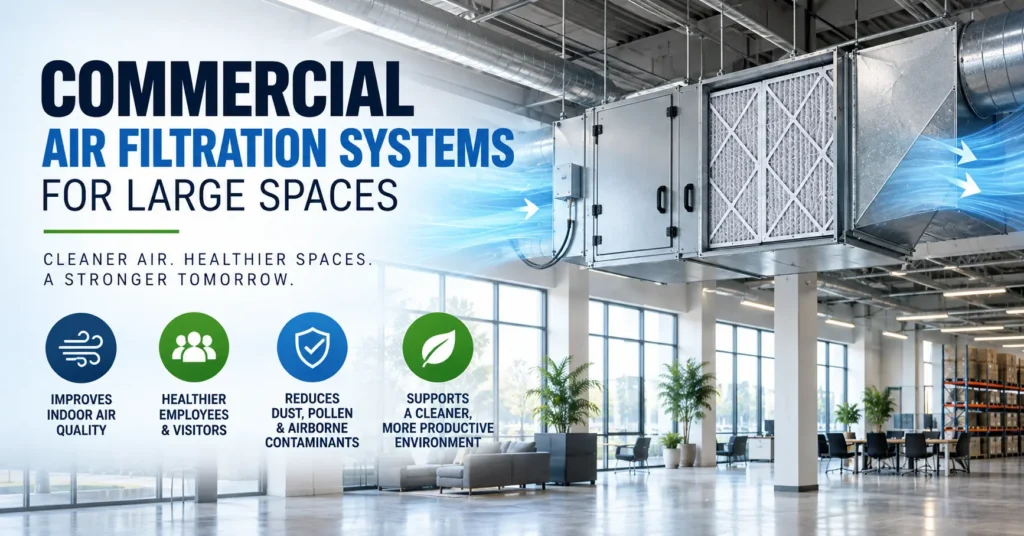
The best commercial air filtration system for a large space depends on the building’s HVAC system, square footage, ceiling height, occupancy, airflow, and the pollutants you need to control. For most commercial buildings, a properly sized HVAC filtration system is the starting point. High-efficiency filters, HEPA systems, and standalone air cleaners can provide additional filtration where needed.
A large office, warehouse, school, gym, or retail facility has very different air-cleaning needs from a single room at home. You need enough airflow to move clean air throughout the space. You also need a filter that the HVAC system can handle without creating excessive resistance.
The good news is that you don’t necessarily need to replace the entire HVAC system. In many cases, the right combination of filtration, airflow, and maintenance can make a significant difference.
What Is the Best Air Filtration System for a Large Commercial Space?
For most large commercial spaces, the best starting point is a properly sized HVAC filtration system with a MERV-rated filter that the system can handle. Additional HEPA or standalone air-cleaning units can supplement the central system in areas that need more particle filtration.
Your existing HVAC system already moves large amounts of air through the building. Using that airflow for filtration can be more practical than relying entirely on portable air purifiers.
However, simply installing the highest-rated filter available isn’t always the right answer. A high-efficiency filter can create more resistance as air moves through it. If the HVAC system isn’t designed for that resistance, airflow may drop.
For that reason, the right system balances three things:
- Filtration efficiency
- Airflow
- System capacity
The goal isn’t to choose the strongest filter on paper. The goal is to provide enough clean air throughout the building without compromising HVAC performance.
Best Commercial Air Filtration Options for Large Spaces
The main options for large commercial spaces are HVAC filtration, MERV-rated filters, HEPA systems, portable air cleaners, and ceiling-mounted filtration units.
Each option has a different role.
Commercial HVAC Filtration Systems
Commercial HVAC filtration is usually the most practical starting point for whole-building air cleaning.
These systems use the building’s existing heating, ventilation, and air-conditioning equipment to filter air as it circulates.
The biggest advantage is coverage. A central HVAC system can move filtered air through multiple rooms or zones.
HVAC filtration can work well in:
- Office buildings
- Retail stores
- Schools
- Hotels
- Large facilities
- Commercial buildings with centralized HVAC
The main consideration is filter compatibility. Before upgrading to a higher-efficiency filter, check whether the HVAC equipment can maintain adequate airflow.
HEPA Air Filtration Systems
HEPA filtration provides very high particle removal and can be useful when a commercial space needs stronger particle filtration.
These filters are designed to capture very small airborne particles. They can be useful in areas where particulate control is especially important.
However, HEPA isn’t automatically the right filter for every commercial HVAC system.
HEPA filters can create more airflow resistance than lower-efficiency filters. Many standard HVAC systems aren’t designed to accommodate a true HEPA filter without modifications.
For that reason, commercial HEPA filtration may work better as:
- A dedicated filtration system
- A standalone air cleaner
- A ceiling-mounted unit
- A properly engineered HVAC installation
The system needs enough airflow to move filtered air through the space effectively.
MERV-Rated Commercial Air Filters
MERV-rated filters are a common choice for commercial HVAC systems because they offer different levels of particle filtration while fitting into existing filter systems.
MERV stands for Minimum Efficiency Reporting Value. The rating provides a standardized way to compare filter performance.
A higher MERV rating generally means the filter can capture smaller particles more effectively.
But higher isn’t automatically better.
A filter with greater efficiency can also increase pressure drop across the filter. If the HVAC system cannot handle that resistance, airflow may decrease.
That’s why the correct MERV rating depends on the HVAC equipment, not just the desired filtration level.
Portable Commercial Air Cleaners
Portable commercial air cleaners are useful when you need additional filtration in specific areas without changing the central HVAC system.
They can be moved to rooms or areas that need extra air cleaning.
This can be useful in:
- Meeting rooms
- Classrooms
- Offices
- Waiting areas
- Gyms
- Temporary workspaces
The important factor is capacity. A small portable unit won’t provide enough clean air for a very large room simply because it has a high-efficiency filter.
Look at the unit’s airflow or clean-air delivery performance and compare it with the size and use of the space.
Ceiling-Mounted and Recirculating Air Cleaners
Ceiling-mounted air cleaners can provide supplemental filtration in large open rooms where central HVAC filtration isn’t enough.
These units circulate room air through a filter and return cleaner air to the space.
They can be particularly useful in large areas with high occupancy or limited HVAC filtration.
Placement matters. You want filtered air to circulate throughout the occupied area rather than creating a small pocket of cleaner air directly underneath the unit.
HEPA vs. MERV Filters for Large Commercial Spaces
HEPA filters generally provide higher particle filtration than many MERV-rated filters, but MERV filters are often easier to integrate into commercial HVAC systems.
The better option depends on the equipment and the building.
| Factor | HEPA | MERV-Rated Filter |
| Particle filtration | Very high | Varies by rating |
| Typical application | Dedicated/high-efficiency systems | Commercial HVAC |
| Airflow resistance | Can be high | Depends on MERV rating |
| Existing HVAC compatibility | System-dependent | Usually easier |
| Whole-building use | Possible with proper design | Common |
| Supplemental filtration | Strong option | Usually part of HVAC |
If your existing HVAC system can safely accommodate the selected filter, a higher-efficiency MERV filter may be a simple upgrade.
If you need very high particle filtration, a dedicated HEPA system may be more appropriate.
The important part is to evaluate the complete system, not just the filter.
How Do You Choose an Air Filtration System for a Large Space?
Choose a commercial filtration system based on space volume, occupancy, HVAC capacity, airflow, and the pollutants you want to remove.
Square footage is only part of the calculation.
Consider the Building Size
The size and volume of the space determine how much filtered air you need.
A 10,000-square-foot building with standard-height ceilings has different requirements from a 10,000-square-foot warehouse with a 30-foot ceiling.
Consider:
- Total square footage
- Ceiling height
- Number of rooms
- Open or divided floor plan
- Number of HVAC zones
Check the HVAC System
The HVAC system determines which filters you can use without creating excessive airflow resistance.
Before changing the filter, consider:
- Existing filter size
- Filter MERV rating
- Fan capacity
- Static pressure
- Airflow
- Equipment specifications
A filter upgrade should not be based on MERV rating alone.
Consider Occupancy
The number of people using the building affects how much clean air the space needs.
A crowded gym has very different requirements from a lightly occupied storage area.
Consider both average and peak occupancy.
High-occupancy areas may benefit from supplemental filtration even when the central HVAC system already uses efficient filters.
Identify the Main Air Quality Problem
Choose filtration based on the pollutant you want to control. Understanding common indoor air quality problems can also help determine which filtration approach is appropriate for the building.
Different technologies work better for different pollutants.
For example:
- Dust and fine particles: HEPA or appropriate MERV filtration
- Pollen: High-efficiency particle filtration
- Pet-related particles: Particle filtration
- Smoke particles: High-efficiency particle filtration
- Certain odors and gases: Activated carbon or other gas-phase filtration
Don’t choose a system simply because it has the highest filtration rating.
Choose one that targets the actual problem.
How Much Air Filtration Does a Large Commercial Space Need?
A large commercial space needs enough clean-air delivery to match its room volume, occupancy, ventilation, and filtration goals.
This is why square footage alone isn’t enough.
Two important measurements often come into play: air changes per hour (ACH) and clean air delivery rate (CADR).
ACH describes how many times the equivalent volume of air in a room is replaced with clean or filtered air over an hour.
CADR describes how quickly an air-cleaning device delivers cleaned air.
For a large space, you need to consider:
- Room volume
- Airflow in CFM
- Existing ventilation
- Filtration efficiency
- Occupancy
- Number and location of air-cleaning units
For example, placing one small air purifier in a large open warehouse won’t provide the same result as using enough filtration capacity to circulate air throughout the entire space.
Clean-air capacity and air distribution matter just as much as filter efficiency.
What MERV Rating Is Best for Commercial Buildings?
The best MERV rating is the highest-efficiency filter that the HVAC system can safely support while maintaining adequate airflow.
There isn’t one MERV rating that’s perfect for every commercial building.
A higher rating can improve particle filtration, but it can also increase resistance to airflow.
Before switching to a higher MERV filter, check:
- The HVAC manufacturer’s specifications.
- The existing filter rating.
- Available fan capacity.
- Pressure drop across the filter.
- Required building airflow.
If the system can’t maintain adequate airflow, installing a higher-rated filter may create problems instead of solving them.
This is why a commercial HVAC professional should evaluate the system before making a major filtration upgrade.
How Much Does a Commercial Air Filtration System Cost?
Commercial air filtration costs vary based on the system type, building size, filtration level, installation requirements, and ongoing maintenance.
A small office may only need upgraded HVAC filters or a few supplemental units.
A large facility may need dedicated filtration equipment, additional ductwork, electrical work, controls, or multiple high-capacity air cleaners.
Your total cost can include:
- Air filtration equipment
- HVAC modifications
- Installation
- Replacement filters
- Energy use
- Preventive maintenance
- Monitoring and testing
Don’t compare systems based only on the purchase price.
A cheaper system may require frequent filter replacement or may not provide enough clean airflow for the building.
Look at the total cost of ownership over the expected life of the system.
How Often Should Commercial Air Filters Be Replaced?
Commercial air filters should be replaced based on filter condition, pressure drop, manufacturer recommendations, and building conditions rather than a fixed schedule alone.
A busy building can load filters much faster than a lightly occupied space.
Replacement frequency can also change because of:
- Construction
- Dust
- Outdoor air quality
- Occupancy
- Building use
- HVAC operating hours
- Filter type
A dirty filter can restrict airflow and reduce HVAC performance.
Regular inspections help you identify when a filter needs replacement before excessive loading becomes a problem. Regular commercial HVAC maintenance can also help keep filtration and airflow working properly.
For critical systems, monitoring pressure drop across the filter can provide a more useful indication than simply replacing filters every few months.
Best Commercial Air Filtration System by Building Type
The best filtration setup depends on the building’s HVAC system and air-quality needs, but some options are more common for certain commercial spaces.
| Building Type | Recommended Starting Point |
| Office | Commercial HVAC filtration |
| School | High-efficiency HVAC filtration where compatible |
| Warehouse | HVAC or dedicated filtration based on pollutants |
| Retail | Central HVAC filtration + supplemental units if needed |
| Gym | High-capacity HVAC + supplemental filtration |
| Large open facility | Central filtration + strategically placed air cleaners |
These are starting points, not universal specifications.
A warehouse with heavy dust exposure may need a very different system from an office in the same building.
The actual solution should account for airflow, room volume, occupancy, and the source of the pollutants.
Common Mistakes When Choosing Commercial Air Filtration
The biggest mistake is choosing a filter based only on its efficiency rating without checking whether the HVAC system can handle it.
Here are several other mistakes to avoid.
Choosing the Highest MERV Rating Automatically
A higher MERV rating can improve filtration, but it can also increase pressure drop.
Always check HVAC compatibility first.
Buying Too Little Filtration Capacity
A highly efficient filter doesn’t help much if the system doesn’t move enough air through it.
Large spaces need enough clean-air delivery to reach the occupied areas.
Ignoring Ceiling Height
Square footage doesn’t tell the whole story.
A building with high ceilings contains much more air than a standard-height room with the same floor area.
Focusing Only on Filter Efficiency
A filter’s efficiency is only one part of the equation.
You also need to consider:
- Airflow
- Pressure drop
- Fan capacity
- Filter surface area
- Maintenance
- Energy use
Ignoring Maintenance
Even a good filtration system needs regular maintenance.
Dirty filters can restrict airflow and reduce system performance. Dirty air ducts can also affect airflow and contribute to indoor air quality problems.
Using Small Portable Units in Huge Spaces
A residential-sized air purifier may work well in a bedroom but provide too little clean air for a large commercial room.
Match the unit’s capacity to the space.
Treating Odors Like Particles
HEPA filters are excellent for particles, but odors often involve gases and volatile compounds.
If odor control is the goal, consider whether activated carbon or another gas-phase filtration method is needed.
Commercial Air Filtration Systems: Which Option Is Best?
For most large commercial buildings, a properly designed HVAC filtration system is the best starting point, with HEPA or standalone air cleaners added when higher particle filtration is needed.
A simple way to think about the options is:
- Whole-building filtration: Commercial HVAC filtration
- High particle filtration: HEPA
- Existing commercial HVAC: An appropriate MERV-rated filter
- Supplemental room filtration: Portable commercial air cleaners
- Large open rooms: High-capacity ceiling-mounted or recirculating units
- Certain odors and gases: Activated carbon or another appropriate gas-phase filter
The right solution isn’t necessarily the system with the highest filter rating.
It is the system that provides enough clean air, works with the building’s HVAC equipment, and can be maintained properly over time.
For a large commercial facility, a professional evaluation can help determine the appropriate filter efficiency, airflow, equipment capacity, and placement before you invest in an upgrade.
Frequently Asked Questions
What is the best air filtration system for a large commercial building?
A properly sized commercial HVAC filtration system is usually the best starting point for a large building. Depending on the building’s needs, HEPA or standalone air-cleaning units can provide additional filtration in specific areas.
What MERV rating is best for commercial buildings?
The best MERV rating is the highest level your HVAC system can support without causing unacceptable airflow restrictions. The correct rating depends on the equipment, building conditions, and filtration goals.
Is HEPA filtration better than MERV?
HEPA generally provides higher particle filtration than most MERV-rated filters, but that doesn’t mean it is automatically better for every commercial HVAC system. HEPA can create higher airflow resistance and may require specially designed equipment.
How do you filter air in a large warehouse?
Large warehouses typically need filtration based on the pollutants present, airflow, ceiling height, and HVAC setup. Depending on the conditions, the solution may include HVAC filtration, dedicated industrial filtration, or strategically placed high-capacity air cleaners.
How much does a commercial air filtration system cost?
The cost depends on building size, system type, filtration efficiency, installation, and maintenance requirements. A simple filter upgrade costs much less than installing a dedicated commercial filtration system.
How often should commercial air filters be replaced?
Replace commercial filters when they become loaded, when pressure drop reaches the recommended limit, or according to the manufacturer’s maintenance guidance. High-dust or high-occupancy buildings may require more frequent replacement.
Can HEPA filters be used in commercial HVAC systems?
HEPA filters can be used in some commercial HVAC applications, but the system must be designed or modified to handle their airflow resistance. Check equipment specifications before installing a HEPA filter in an existing system.
How many air purifiers are needed for a large commercial space?
The number depends on the size and volume of the space, the capacity of each unit, existing HVAC airflow, occupancy, and the desired clean-air delivery. One small unit is unlikely to provide enough filtration for a very large commercial area.
Final Takeaway
Choosing a commercial air filtration system isn’t just about finding the filter with the highest rating.
The best system is the one that provides enough clean air for the space while working properly with the building’s HVAC equipment.
For many large commercial spaces, that starts with an appropriately selected MERV-rated HVAC filter. HEPA systems and high-capacity standalone units can then provide additional particle filtration where the building needs it most.
Before upgrading filtration, look at the complete system: space volume, occupancy, airflow, pressure drop, filter efficiency, pollutant type, and maintenance requirements.
That approach gives you a filtration system that works for the building, not just a filter that looks impressive on paper.
Need Help Choosing a Commercial Air Filtration System?
The right commercial air filtration system starts with a proper evaluation of your building, HVAC equipment, airflow, and indoor air quality needs.
If you’re unsure which filter or filtration system is right for your facility, a commercial HVAC professional can assess your existing system and recommend an appropriate solution.
A professional evaluation can help determine:
- Which MERV rating your HVAC system can safely handle
- Whether HEPA filtration is practical for your building
- How much filtration capacity your space needs
- Whether supplemental air-cleaning units would help
- How often your commercial filters should be replaced
- Whether airflow or HVAC performance could be affected by a filter upgrade
Don’t guess when it comes to a large commercial building. Get your air filtration system evaluated before investing in new equipment or filters.
Contact G4 Electrical, Plumbing & Air today to schedule a commercial air filtration assessment and find the right filtration solution for your building.