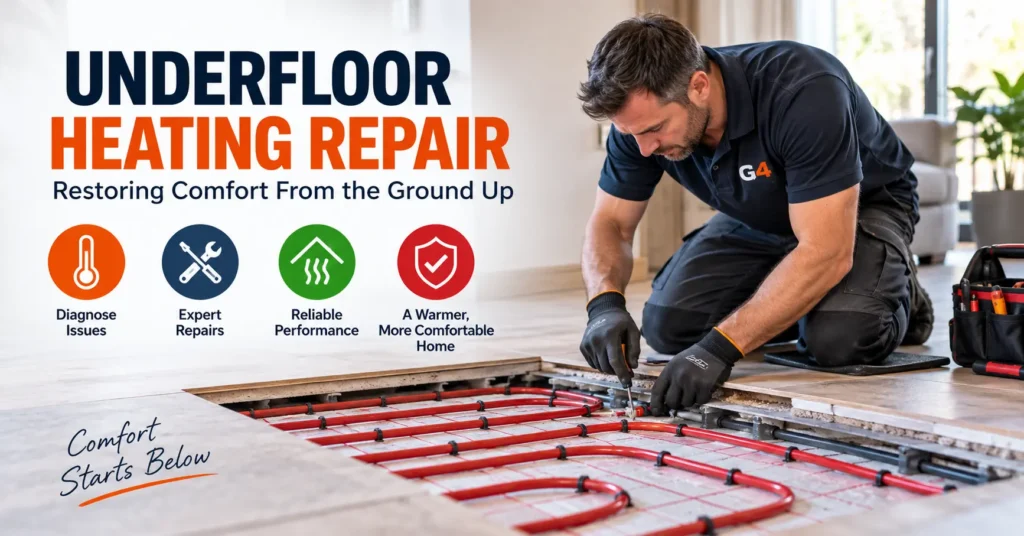
Underfloor heating usually needs repair when it stops heating, develops cold spots, heats unevenly, or shows signs of an electrical or water-related fault. The good news is that many problems can be repaired without replacing the entire system.
The repair cost depends on the type of underfloor heating you have and what’s gone wrong. Electric systems can develop thermostat, sensor, wiring, or heating-element problems. Hydronic systems can have issues with pumps, valves, boilers, pressure, or pipes.
Before replacing the system, it’s worth finding the actual fault. A proper diagnosis can tell you whether a simple component repair is enough or whether a larger repair is needed.
What Are the Signs Your Underfloor Heating Is Failing?
Common signs of failing underfloor heating include cold spots, uneven heating, no heat, slow warm-up, thermostat problems, repeated breaker trips, and water leaks in hydronic systems.
Not every problem means the heating system itself has failed. A faulty thermostat or sensor can cause the same symptoms as a damaged heating element.
Here are the main warning signs to watch for.
Parts of the Floor Stay Cold
Cold spots often indicate a problem with a heating cable, heating mat, hydronic loop, or water circulation.
If one section of the floor stays cold while the rest heats normally, the problem may be localized.
With electric underfloor heating, a damaged cable or mat can stop heat from reaching part of the floor.
With hydronic heating, poor water circulation or a problem with a specific loop can create cold areas.
The location and pattern of the cold spot can help a technician narrow down the fault.
The Floor Doesn’t Heat Up at All
If the entire floor stays cold, the problem may be the thermostat, power supply, heating element, boiler, pump, or another system component.
Start with the simplest checks.
Make sure the thermostat is set to a temperature above the current room temperature. Check whether the thermostat display is working and whether the system has power.
If the controls appear normal but the floor remains cold, the system needs further testing.
For hydronic systems, the problem may be outside the floor itself. A boiler, pump, valve, or circulation problem can prevent heated water from reaching the floor.
Heating Is Uneven or Takes Too Long
Uneven or slow heating can point to poor water circulation, a faulty sensor, damaged heating elements, or a system that isn’t operating correctly.
Some underfloor heating systems naturally warm up more slowly than conventional radiators. That’s not necessarily a fault.
However, a noticeable change in performance is worth investigating.
If a floor used to heat evenly and now takes much longer or leaves cold areas, something may have changed.
The Thermostat Isn’t Working Properly
A faulty thermostat can prevent underfloor heating from turning on, turning off, or maintaining the correct temperature.
Common thermostat problems include:
- Blank display
- Incorrect temperature readings
- System not responding to temperature changes
- Heating staying on continuously
- Heating not turning on
- Error messages
A thermostat problem can sometimes be much simpler and less expensive to fix than a damaged heating element.
The Circuit Breaker Keeps Tripping
A breaker that repeatedly trips can indicate an electrical fault and should not be ignored.
A damaged heating cable, wiring problem, moisture issue, or electrical fault may cause the circuit to trip.
Don’t keep resetting the breaker and hoping the system starts working.
If the breaker trips again, switch the system off and have the electrical fault checked by a qualified professional.
You Notice Water or Damp Spots
Water or dampness around a hydronic underfloor heating system can indicate a leaking pipe, connection, manifold, or other component.
Electric systems don’t circulate water, so this particular problem applies to hydronic systems.
A leak can cause pressure loss and reduce heating performance. It can also damage flooring or other parts of the building.
If you see unexplained dampness, arrange an inspection promptly.
What Causes Underfloor Heating to Stop Working?
Underfloor heating can stop working because of thermostat faults, damaged heating elements, sensor problems, electrical faults, poor water circulation, boiler issues, or leaks.
The cause depends heavily on whether your system uses electricity or heated water.
Common causes include:
Faulty Thermostat
A thermostat controls when the heating system operates.
If it fails or reads the room temperature incorrectly, the system may not turn on or may run at the wrong times.
Damaged Heating Cable or Mat
Electric underfloor heating relies on heating cables or mats beneath the floor.
Damage to these components can create cold spots or stop part of the system from heating.
Finding the damaged section is important because it may be possible to repair the affected area instead of replacing the entire system.
Failed Temperature Sensor
A failed floor or temperature sensor can cause the system to behave incorrectly even when the heating element itself is working.
The sensor tells the thermostat how warm the floor or room is.
If it gives an incorrect reading, the thermostat may shut the system off too early or fail to activate it when needed.
Electrical Connection Problems
Loose, damaged, or faulty electrical connections can prevent an electric underfloor heating system from operating safely.
Electrical faults require proper testing.
Don’t attempt to repair concealed wiring yourself unless you’re appropriately qualified to do so.
Boiler or Circulation Problems
Hydronic underfloor heating can stop warming the floor when the boiler, circulation pump, valve, or other water-side component isn’t working correctly.
The heating pipes may be intact, but heated water isn’t reaching them properly.
This is why it’s important to diagnose the complete system instead of assuming the floor itself has failed.
Air or Pressure Problems in Hydronic Systems
Air trapped in the system or incorrect water pressure can reduce circulation and cause poor heating.
Hydronic systems rely on proper water circulation through their heating loops.
If pressure is too low or air enters the system, some areas may heat poorly or remain cold.
Damaged Pipes or Leaks
A damaged hydronic pipe can cause pressure loss, poor heating, and water damage.
Pipe problems can be more difficult to repair when the pipe is located beneath finished flooring.
Early diagnosis can help limit the amount of floor access needed.
Electric vs. Hydronic Underfloor Heating Repair
Electric systems usually need electrical, thermostat, sensor, or heating-element repairs, while hydronic systems can also develop boiler, pump, valve, pressure, and pipe problems.
| Repair Factor | Electric | Hydronic |
| Heat source | Electricity | Heated water |
| Common faults | Cable, mat, thermostat, sensor | Pump, valve, boiler, pipe, pressure |
| Water leak risk | No | Yes |
| Electrical troubleshooting | Common | May still be required |
| Floor access | Sometimes | Depends on fault |
| Professional diagnosis | Recommended | Recommended |
Knowing which type of system you have makes it easier to understand the likely repair.
If you’re unsure, a technician can usually identify the system during an inspection.
Can Underfloor Heating Be Repaired Without Removing the Floor?
Yes, some underfloor heating problems can be repaired without removing large sections of flooring, but it depends on which component has failed and where the fault is located.
Thermostats and some sensors can often be accessed without disturbing the floor.
The same may apply to accessible pumps, valves, manifolds, and other components in hydronic systems.
A damaged heating cable or pipe is more complicated.
A technician may need to locate the exact fault first. Specialized testing can sometimes identify the damaged section before any flooring is opened.
That can help limit unnecessary floor removal.
The key is accurate fault detection before starting invasive repairs.
How Much Does Underfloor Heating Repair Cost?
Underfloor heating repair costs vary based on the system type, failed component, labor, accessibility, and whether flooring needs to be opened.
There isn’t one reliable price for every repair.
A thermostat replacement is generally a much simpler job than locating and repairing a damaged heating cable beneath finished flooring.
Your final repair cost may depend on:
- Electric or hydronic system
- Type of failed component
- Size of the affected area
- Location of the fault
- Flooring type
- Accessibility
- Diagnostic work
- Replacement parts
- Labor
- Whether flooring needs to be removed and restored
Thermostat Repair or Replacement
Thermostat problems are often among the simpler underfloor heating repairs because the thermostat is normally accessible.
The technician can test the thermostat and wiring to determine whether the control itself has failed.
If it needs replacement, the job may not require any work beneath the floor.
Temperature Sensor Repair
A temperature sensor can often be replaced, but access depends on how the original sensor was installed.
Some systems place the sensor in a conduit, making replacement easier.
If the sensor is inaccessible, the repair may require a different approach.
Heating Cable or Mat Repair
Heating cable or mat repairs can cost more because the fault may be beneath finished flooring.
The first step is locating the damaged section.
Once the fault is identified, a technician can determine whether the affected section can be repaired.
The amount of floor access required has a major effect on the final cost.
Hydronic Pipe or Manifold Repair
Hydronic repairs can range from a simple manifold or connection repair to a more involved pipe repair beneath the floor.
The location of the leak matters.
An accessible manifold connection is much easier to repair than a damaged pipe buried beneath tile or another finished floor.
Pump, Valve, or Boiler-Related Repair
A hydronic underfloor heating problem may come from the pump, valve, or boiler rather than the floor heating loop itself.
That’s why replacing floor components without proper testing can be a costly mistake.
A complete system check can identify whether the problem is actually coming from the heating source or circulation system.
How Is Underfloor Heating Diagnosed?
A technician diagnoses underfloor heating by checking the thermostat, power supply, sensors, heating elements, water circulation, and other components that affect system performance.
The diagnostic process depends on the system type.
Electric Underfloor Heating
A technician may:
- Check the thermostat.
- Confirm the electrical supply.
- Test the heating circuit.
- Check the temperature sensor.
- Measure electrical resistance.
- Identify a damaged section if the heating element has failed.
The goal is to locate the fault before opening the floor.
Hydronic Underfloor Heating
A technician may:
- Check the boiler or heat source.
- Check system pressure.
- Inspect the circulation pump.
- Check valves and controls.
- Inspect the manifold.
- Check water circulation through the loops.
- Look for signs of leaks.
- Test affected areas if necessary.
This approach helps determine whether the problem is inside the floor or somewhere else in the heating system.
Can You Repair Underfloor Heating Yourself?
You can perform a few basic checks yourself, but electrical faults, damaged heating elements, leaks, and boiler or circulation problems should be handled by a qualified professional.
Safe checks include:
- Confirming the thermostat is set correctly
- Checking whether the thermostat has power
- Checking basic system controls
- Looking for visible leaks on accessible hydronic components
Avoid opening electrical components if you aren’t qualified to work on them.
You also shouldn’t cut into flooring to search for a heating cable or pipe fault.
A professional can test the system first and may be able to locate the problem without unnecessary damage to the floor.
When Should You Call a Professional for Underfloor Heating Repair?
You should call a professional when the heating stops working, cold spots persist, a breaker repeatedly trips, you find a leak, or the system needs electrical or water-side repairs.
Don’t wait if you notice:
- No heat across the entire floor
- Persistent cold spots
- Repeated circuit-breaker trips
- Burning smells
- Unusual electrical behavior
- Water leaks
- Falling hydronic pressure
- Boiler or pump problems
- A thermostat that doesn’t respond
- A suspected damaged heating cable or pipe
Some faults are minor. Others can cause additional damage if you continue operating the system. Similar warning signs can indicate the need for heating system repair.
Early diagnosis can also make repairs easier and potentially reduce the amount of flooring that needs to be disturbed.
Repair or Replace Underfloor Heating?
Repair is often the better option when the problem involves a replaceable component. Replacement may be more practical when the system has widespread damage or fixing it would require extensive floor removal.
Repair May Make More Sense When:
- The fault is localized
- The heating system is otherwise reliable
- The thermostat or sensor has failed
- A pump or valve needs replacement
- A small section of heating cable can be repaired
- The repair is accessible
Replacement May Make More Sense When:
- Multiple parts are failing
- The heating elements have widespread damage
- The system is near the end of its useful life
- Accessing the damaged area requires extensive floor removal
- Repair costs are approaching replacement costs
Don’t make the decision based on the age of the system alone.
A proper diagnosis gives you a better idea of whether repair or replacement is financially sensible. Comparing the cost of repair or replacement can also help when deciding whether continued repairs are worthwhile.
How to Prevent Underfloor Heating Problems
Regular inspections, proper maintenance, and early attention to unusual heating behavior can help prevent minor underfloor heating problems from becoming larger repairs.
A few simple habits can help:
- Don’t ignore new cold spots.
- Have recurring thermostat problems checked.
- Maintain hydronic boilers and pumps.
- Monitor unusual pressure changes.
- Address leaks quickly.
- Follow the manufacturer’s maintenance recommendations.
- Have electrical problems professionally inspected.
- Replace worn components when necessary.
If the system suddenly performs differently, it’s better to investigate early rather than wait for it to stop working completely.
Underfloor Heating Repair: What Should You Do First?
Start by checking the thermostat and identifying whether the problem affects the entire floor or only certain areas.
Then:
- Check the thermostat settings.
- Confirm the system has power.
- Note whether the floor is completely cold or heating unevenly.
- Look for visible leaks if you have a hydronic system.
- Don’t repeatedly reset a circuit breaker that keeps tripping.
- Arrange professional testing if the problem continues.
The most important step is finding the actual cause.
A failed thermostat doesn’t require the same repair as a damaged heating cable. Likewise, a hydronic circulation problem may have nothing to do with the floor pipes themselves.
Need Underfloor Heating Repair?
If your underfloor heating isn’t warming the room properly, a professional inspection can identify the fault and determine whether repair or replacement makes more sense.
A qualified technician can test the system, locate the problem, and recommend the appropriate repair instead of replacing components unnecessarily.
Professional service can help with:
- Underfloor heating diagnostics
- Thermostat problems
- Temperature sensor faults
- Electric heating cable issues
- Hydronic circulation problems
- Pump and valve problems
- Leaks and pressure issues
- System performance checks
Don’t replace the entire system before finding out what’s actually wrong.
Contact G4 Electrical, Plumbing & Air today to schedule underfloor heating repair and get your system checked by a professional.
Frequently Asked Questions
How do I know if my underfloor heating is broken?
Cold spots, no heat, uneven heating, thermostat problems, repeated breaker trips, and hydronic leaks can indicate a fault. A professional inspection can identify whether the problem is with the heating element, controls, or another component.
Can underfloor heating be repaired?
Yes, many underfloor heating problems can be repaired without replacing the entire system. Common repairs include thermostats, sensors, electrical components, pumps, valves, and localized heating-element faults.
How much does it cost to repair underfloor heating?
The cost depends on the system type, failed component, labor, accessibility, and whether flooring needs to be opened. A thermostat repair is typically much simpler than repairing a concealed heating cable or pipe.
Why is my underfloor heating not heating up?
The cause could be a thermostat fault, power problem, damaged heating element, sensor issue, boiler problem, pump failure, or poor water circulation. The correct cause needs to be diagnosed before choosing a repair.
Why is my underfloor heating only warm in some areas?
Uneven heating can result from a damaged heating cable, faulty heating mat, poor water circulation, trapped air, or a problem with a hydronic loop. The pattern of the cold areas can help identify the cause.
Can underfloor heating be repaired without removing the floor?
Some faults can be repaired without removing flooring, especially thermostat and accessible component problems. If a heating cable or pipe beneath the floor is damaged, limited access may be necessary after the fault is located.
How long does underfloor heating repair take?
Repair time depends on the fault and how accessible the failed component is. A thermostat or accessible component may be repaired relatively quickly, while concealed cable or pipe repairs can take longer.
Is it cheaper to repair or replace underfloor heating?
Repair is usually cheaper when the problem is limited to one component, while replacement may make more sense when damage is widespread or access is difficult. A professional diagnosis can help compare the two options.
Can I repair underfloor heating myself?
Basic thermostat checks may be possible, but electrical faults, heating-element repairs, leaks, and boiler or circulation problems should be handled by a qualified professional. DIY repairs can create electrical, water, or flooring damage.
How long does underfloor heating last?
The lifespan of underfloor heating depends on the system type, installation quality, operating conditions, and maintenance. If an older system develops repeated faults, compare the cost of continued repairs with replacement before making a decision.