A whole-house air filtration system can be worth the cost if you want to reduce airborne particles throughout your home, but the value depends on your indoor-air concerns, HVAC system, and installation cost.
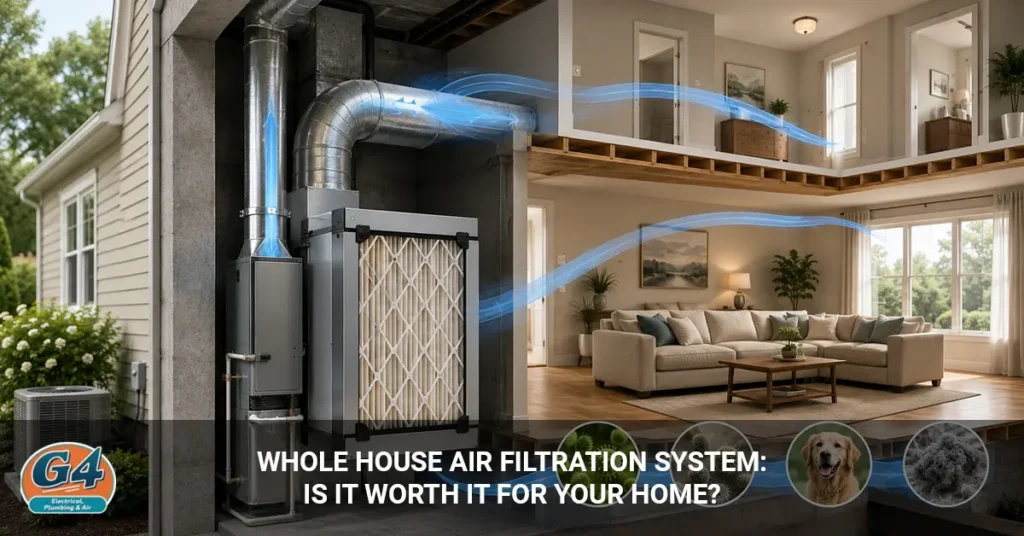
Unlike a portable air purifier that cleans one room, a whole-house air filtration system works with your central HVAC system. It filters air as the system circulates it through the home’s ductwork.
A properly selected system can help reduce dust, pollen, pet dander, and other airborne particles. However, a higher-efficiency filter isn’t automatically better for every HVAC system. You also need to consider airflow, filter size, MERV rating, replacement costs, and your home’s specific needs.
What Is a Whole House Air Filtration System?
A whole-house air filtration system filters air throughout your home as your central HVAC system circulates it.
Most systems sit near the return-air side of the furnace or air handler. As the HVAC system pulls indoor air through the return duct, the filter captures airborne particles before the system sends the filtered air back through the supply ducts.
Compared with using separate portable air purifiers in individual rooms, a whole-house filter can provide:
- Whole-home coverage through the central ductwork
- Centralized filtration with one main filter
- Less floor space used inside living areas
- Filtration whenever the HVAC system circulates air
- Larger filter options that can hold more particles before replacement
The system only filters air when the HVAC system moves air through the filter. Choosing the right filter size and efficiency also matters because an overly restrictive filter can reduce airflow.
Whole House Air Filter vs. Standard HVAC Filter
A whole-house air filtration system typically uses a larger, deeper, or higher-capacity filter than a basic 1-inch HVAC filter.
A standard furnace or air-conditioner filter helps protect the HVAC equipment while capturing some airborne particles. Many whole-house systems use deeper media filters with more surface area. That larger surface area can provide good particle capture while keeping airflow resistance manageable.
The key isn’t simply choosing the highest MERV rating. Your HVAC system needs adequate airflow with the filter you install. An overly restrictive filter can increase static pressure and affect system performance.
Whole House Air Filter vs. Portable Air Purifier
A whole-house filter uses the central HVAC system to filter air throughout the home, while a portable air purifier usually targets one room or a smaller area.
| Whole-House Air Filter | Portable Air Purifier |
| Works with central HVAC | Works independently |
| Can provide filtration throughout the home | Usually targets one room |
| Installs in the HVAC duct system | Sits inside the living space |
| Must match HVAC airflow requirements | Doesn’t depend on central HVAC |
| Uses replaceable HVAC filters | Uses its own replacement filters |
| May require professional installation | Usually simple to set up |
A portable purifier may make more sense for one bedroom, office, or other specific room. A whole-house system can make more sense when you want centralized filtration throughout the home.
The choice also depends on how often your HVAC system runs. A portable unit can keep filtering a room even when the central HVAC system isn’t operating.
How Does a Whole House Air Filtration System Work?
A whole-house air filtration system captures airborne particles as indoor air passes through the HVAC filter.
The process works like this:
- The HVAC system pulls indoor air through the return duct.
- The air passes through the filtration system.
- The filter captures airborne particles such as dust, pollen, and pet dander.
- The HVAC system heats or cools the filtered air as needed.
- The system sends the conditioned air back through the supply ducts.
The filter works whenever the HVAC system circulates air. If your HVAC system doesn’t run often, the filter won’t continuously clean the air. A portable air purifier can continue filtering a specific room independently of the central HVAC system.
For the best results, use a filter that provides the level of filtration you need without restricting the airflow your HVAC system requires.
What Does a Whole House Air Filter Remove?
A whole-house air filter can capture airborne particles such as dust, pollen, pet dander, and some smoke particles, depending on the filter’s efficiency and design.
The filter’s MERV rating, construction, and airflow affect which particles it can capture. No standard HVAC filter removes every type of indoor pollutant.
Does a Whole House Filter Remove Mold?
A whole-house filter can capture some airborne mold particles, but it won’t remove the moisture source that allows mold to grow.
If you have visible mold or a moisture problem, fix the underlying source first. Filtration can reduce some airborne particles, but it doesn’t replace moisture control or appropriate mold remediation.
Does a Whole House Filter Remove Dust?
Yes, a properly selected whole-house filter can capture airborne dust particles as they pass through the HVAC system.
How much dust it captures depends on the filter’s efficiency, HVAC runtime, filter condition, and the amount of dust entering the home.
Replace the filter according to the manufacturer’s recommendations and check it regularly. A loaded filter can restrict airflow and reduce HVAC performance.
Does a Whole House Filter Help With Pet Dander?
Yes, an appropriate HVAC filter can capture airborne pet dander and other pet-related particles.
However, filters won’t capture every particle that has already settled on carpets, furniture, bedding, or other surfaces. Regular vacuuming, cleaning, and pet grooming still help control those particles.
Does a Whole House Filter Remove Smoke?
A high-efficiency particle filter can capture many airborne smoke particles, but a standard particle filter won’t remove all smoke gases or odors.
If smoke or strong odors are your main concern, you may need a filtration system that combines particle filtration with gas-phase filtration, such as activated carbon.
Choose the filtration technology based on the pollutant you want to remove rather than assuming one filter can handle everything.
What Are the Benefits of a Whole House Air Filtration System?
The main benefit of a whole-house air filtration system is centralized particle filtration throughout your home whenever the HVAC system circulates air.
A properly selected filter can provide several practical benefits:
- Less airborne dust circulating through the home
- Reduced airborne pollen entering rooms through the HVAC system
- Less airborne pet dander when the filter can capture those particles
- Fewer airborne particles moving through the ductwork
- Whole-home coverage instead of treating one room at a time
- Less need for multiple portable air cleaners
- Simpler filter maintenance with one central filtration point
- Reduced particle buildup inside some HVAC components
If your home has excessive dust or poor airflow, dirty air ducts may also be contributing to the problem.
A whole-house system can also make routine maintenance easier because you manage one central filter instead of maintaining several portable units.
However, air filtration doesn’t solve every indoor-air problem. A filter won’t fix high humidity, a water leak, poor ventilation, or the source of chemical pollution.
If moisture or ventilation causes your indoor-air problem, address that underlying issue rather than relying on filtration alone.
What Are the Disadvantages of a Whole House Air Filtration System?
The main disadvantages of a whole-house air filtration system are the upfront installation cost, ongoing filter expenses, and possible airflow problems if you choose a filter that doesn’t match your HVAC system.
Other drawbacks include:
- Higher upfront cost than a basic HVAC filter
- Ongoing replacement-filter expenses
- Space requirements for the filter cabinet or housing
- Dependence on the central HVAC system for air circulation
- Potential airflow restrictions from an overly restrictive filter
- Limited odor and gas removal with standard particle filters
- Professional installation for some filtration systems
The most important issue is airflow. A high-efficiency filter can capture smaller particles, but it can also create more resistance depending on its design and the HVAC system.
Don’t choose a filter based only on its MERV rating. Make sure the filter size, efficiency, and system design work together to maintain proper HVAC airflow.
How Much Does a Whole House Air Filtration System Cost?
A whole-house air filtration system can cost several hundred to more than $2,000 installed, depending on the equipment, filter type, HVAC setup, and installation work required.
Basic media filtration usually costs less than electronic air cleaners or more specialized systems. Your total project cost may include:
- Filtration equipment
- Installation labor
- Filter cabinet or housing
- Duct modifications
- Electrical work for powered systems
- Replacement filters
- Maintenance
| System Type | Relative Cost | Typical Use |
| Basic media filter | Lower | General dust and particle filtration |
| High-efficiency media filter | Moderate | Higher particle capture |
| Electronic air cleaner | Higher | Enhanced particle filtration |
| Advanced filtration system | Higher | Specific indoor-air concerns |
These are general cost categories, not fixed installation prices. Local labor rates, equipment requirements, and the condition of your existing HVAC system can change the final cost.
Before choosing a system, ask the contractor for an itemized estimate that separates equipment, installation, ductwork or electrical modifications, and ongoing filter costs. This gives you a better picture of the total investment.
How Much Does It Cost to Replace a Whole House Air Filter?
Whole-house filter replacement costs vary by filter size, MERV rating, brand, and system design.
Larger and higher-efficiency filters generally cost more than basic 1-inch filters. Some whole-house systems also use less common filter sizes, which can affect availability and price.
Before installing a system, check the replacement-filter cost and availability. A system with a low upfront price can cost more over time if its filters are expensive or difficult to find.
How Often Do Whole House Filters Need Replacement?
Most whole-house filters need replacement according to the manufacturer’s recommended schedule and the actual conditions inside your home.
How often you need to change the filter can depend on:
- Pets
- Number of occupants
- Home size
- Indoor dust levels
- Construction or remodeling
- HVAC runtime
- Filter efficiency
There isn’t one replacement schedule that works for every home. Check the filter regularly rather than relying only on the calendar. If the filter looks heavily loaded with dust or you notice reduced airflow, check whether it needs replacement.
Always follow the filter and HVAC manufacturer’s recommendations for the specific system.
Regular HVAC maintenance can also help keep the system operating efficiently and identify potential airflow problems. Follow a thorough HVAC maintenance checklist to keep up with routine care.
Is a Whole House Air Filtration System Worth It?
A whole-house air filtration system can be worth the investment if you want centralized particle filtration and your HVAC system can handle the selected filter without excessive airflow restriction.
It may provide good value if you:
- Have excessive household dust
- Have pets that add airborne dander
- Deal with seasonal pollen
- Want filtration throughout the home
- Don’t want multiple portable air purifiers
- Run your central HVAC system regularly
When a Whole House Filter May Not Be Worth It
A whole-house system may not be the best choice if you only need filtration in one room or your main indoor-air problem isn’t airborne particles.
It may make less sense if you:
- Only need filtration in one room
- Rarely run your central HVAC system
- Mainly have a humidity problem
- Have an unresolved moisture or mold source
- Mainly want to remove odors or gases
- Have an HVAC system that can’t support the selected filter
For example, a whole-house filter won’t fix a leaking pipe, high indoor humidity, or the source of mold growth. Those problems require a different solution.
The best system isn’t necessarily the most expensive one. Choose filtration that addresses your actual air-quality concern while maintaining proper HVAC airflow and keeping long-term filter costs reasonable.
What MERV Rating Should You Choose?
Choose a MERV rating that provides the particle filtration you need without creating excessive airflow resistance for your HVAC system.
MERV stands for Minimum Efficiency Reporting Values. The rating helps compare how effectively HVAC filters capture different particle sizes.
Common residential options include:
- MERV 8: Provides basic filtration for common household particles such as dust and pollen.
- MERV 11: Provides higher particle filtration and can capture more smaller airborne particles.
- MERV 13: Provides higher-efficiency filtration for finer particles and can be useful when you need stronger particle control.
A higher MERV rating doesn’t automatically make a filter better for your HVAC system. Some higher-efficiency filters can create more airflow resistance, depending on their design and size.
Before upgrading to a higher MERV filter, check your HVAC manufacturer’s recommendations. If you’re unsure whether your system can handle the filter, have an HVAC professional check airflow and static pressure.
The goal is to balance filtration performance with proper HVAC airflow, rather than simply choosing the highest MERV rating available.
Whole House Air Filtration vs. Air Purification
Air filtration primarily captures airborne particles, while air purification can use different technologies to target particles, gases, odors, or other contaminants. If you’re comparing different air-cleaning technologies, see our guide to ozone air filtration vs HEPA to understand the differences in safety and effectiveness.
| Feature | Air Filtration | Air Purification |
| Dust | Good–Excellent | Varies by technology |
| Pollen | Good–Excellent | Varies by technology |
| Pet dander | Good–Excellent | Varies by technology |
| Smoke particles | Good–Excellent | Varies by technology |
| Odors | Limited with standard filters | Depends on technology |
| VOCs | Limited with standard filters | Depends on technology |
| Whole-home operation | Yes, with central HVAC | Depends on the system |
A standard mechanical filter captures particles as air passes through the filter. Other air-cleaning technologies can use methods such as activated carbon or electronic particle collection.
For example, activated carbon can help with certain gases and odors, while mechanical filters primarily target particles.
Choose the technology based on the pollutant you want to address. If dust and pollen are your main concerns, mechanical filtration may be enough. If odors or certain gases are the problem, you may need a different or combined filtration approach.
What Should You Consider Before Installing One?
Before installing a whole-house air filtration system, check HVAC compatibility, filter size, airflow requirements, installation space, and long-term filter costs.
HVAC System Capacity
Your HVAC system needs enough airflow capacity to operate properly with the selected filter.
A restrictive filter can increase static pressure and reduce airflow. That can affect heating and cooling performance and may increase strain on the system.
If you’re moving to a higher-efficiency filter, have an HVAC professional confirm that your system can handle it.
If you’re unsure whether your existing system can support a new filtration setup, a professional HVAC service can help evaluate your system and airflow requirements.
Existing Filter Size
Check your existing filter size and filter housing before choosing a whole-house system.
A deeper media filter may require a new filter cabinet or modifications to the return-air ductwork. Don’t assume that a larger filter will fit your existing setup.
MERV Rating
Choose the MERV rating based on your filtration needs and HVAC requirements rather than simply choosing the highest rating.
Higher filtration can provide better particle capture, but the filter also needs to allow adequate airflow through the system.
Filter Availability
Choose a system that uses replacement filters you can easily find and afford.
Before installation, check:
- Filter dimensions
- MERV rating
- Replacement cost
- Local availability
- Expected replacement frequency
A system that uses an uncommon filter size can become inconvenient and expensive to maintain.
Long-Term Operating Costs
Consider filter replacement and maintenance costs when comparing whole-house filtration systems.
Don’t focus only on the initial installation price. A less expensive system can cost more over several years if it requires expensive or frequent filter replacements.
Compare the upfront installation cost with ongoing filter and maintenance expenses before making your decision.
How to Choose a Whole House Air Filtration System
Choose a whole-house air filtration system based on your indoor-air concern, HVAC compatibility, required filtration level, installation needs, and long-term cost.
Check the Filter Rating
Choose a filter rating that matches the particles you want to capture and what your HVAC system can handle.
Don’t automatically choose the highest MERV rating. A more restrictive filter may reduce airflow if your HVAC system doesn’t have enough capacity to handle it.
Check HVAC Compatibility
Confirm that your HVAC system can maintain adequate airflow with the selected filter before installation.
If you’re unsure, have an HVAC professional evaluate the system and recommend a suitable filter size and efficiency.
Compare Filter Replacement Costs
Compare replacement-filter prices and availability before buying the system.
You’ll need to replace filters throughout the system’s life, so this recurring expense matters. Check the exact filter size and MERV rating rather than comparing only the equipment’s purchase price.
Consider Installation Requirements
Check whether the system requires a new filter cabinet, duct modifications, electrical work, or other installation changes.
A basic media filter may require relatively little modification, while powered or specialized systems can require additional installation work.
Look at Long-Term Operating Costs
Compare installation, filter replacement, maintenance, and other operating costs rather than focusing only on the initial purchase price.
A system with a higher upfront cost may provide better long-term value if it uses affordable filters and requires minimal maintenance.
The best whole-house air filtration system is the one that solves your specific air-quality problem without compromising HVAC performance or creating unreasonable ongoing costs.
Frequently Asked Questions
Is a whole house air filtration system worth it?
A whole-house air filtration system can be worth the investment if you want centralized particle filtration throughout your home and your HVAC system can support the selected filter.
How much does a whole house air filtration system cost?
A whole-house air filtration system can cost several hundred to more than $2,000 installed, depending on the equipment, HVAC setup, and installation requirements.
What is the best MERV rating for a whole house filter?
The best MERV rating depends on your filtration needs and what your HVAC system can handle without excessive airflow restriction. MERV 8, 11, and 13 are common residential options.
Does a whole house air filter remove dust?
Yes, a properly selected whole-house filter can capture airborne dust particles as the HVAC system circulates air.
Does a whole house filter help with allergies?
A properly selected filter can reduce airborne particles such as pollen and pet dander, which may help improve indoor air quality.
Does a whole house filter remove mold?
A whole-house filter can capture some airborne mold particles, but it won’t remove the moisture source or fix an active mold problem.
How often should I change a whole house air filter?
Change the filter according to the manufacturer’s recommendations and inspect it regularly because homes with pets, high dust levels, or frequent HVAC use may need more frequent replacement.
Can a whole house filter damage an HVAC system?
A properly selected filter shouldn’t damage a compatible HVAC system, but an excessively restrictive filter can reduce airflow and increase system strain.
Are whole house air filters better than portable air purifiers?
Whole-house filters provide centralized filtration, while portable air purifiers can provide targeted filtration in individual rooms. The better option depends on your home’s layout, HVAC system, and air-quality needs.
Do whole house air filters reduce odors?
Standard particle filters have limited ability to remove odors because many odors come from gases rather than particles. A system with appropriate gas-phase filtration, such as activated carbon, may work better for certain odors.
Final Thought
A whole-house air filtration system can be a worthwhile investment when you want centralized particle filtration and choose a system that matches your HVAC equipment.
It can help reduce airborne dust, pollen, pet dander, and other particles throughout the home. However, higher filtration isn’t automatically better. A filter that’s too restrictive for your HVAC system can reduce airflow and affect system performance.
Before installing one, compare the MERV rating, HVAC compatibility, installation cost, replacement-filter price, and long-term maintenance requirements.
Most importantly, choose a system that addresses the actual air-quality problem in your home. You don’t need to pay for higher filtration or features that your home and HVAC system don’t require.